>
Stomiiformes (Lightfishes and dragonfishes) >
Stomiidae (Barbeled dragonfishes) > Astronesthinae
Etymology: Astronesthes: Greek, astra = ray + Greek, esthes, -es = suit, something used to wrap (Ref. 45335).
Eponymy: The fallen angel Lucifer, of the Judeo-Christian tradition, is referred to in the fourteenth chapter of the Biblical book of Isaiah: ‘How art thou fallen from heaven, O Lucifer, son of the morning! How art thou cut down to the ground, which didst we [...] (Ref. 128868), visit book page.
More on author: Gilbert.
Environnement : milieu / zone climatique / profondeur / gamme de distribution
Écologie
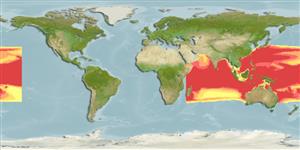
marin bathypélagique; profondeur 25 - 704 m (Ref. 58302). Deep-water; 36°N - 33°S, 43°E - 154°W
Indo-Pacific: Japan, off the Hawaiian Islands, and the Timor Sea. Reported from Taiwan (Ref. 5193), Australia (Ref. 7300), and Yemen (Ref. 28061).
Taille / Poids / Âge
Maturité: Lm ? range ? - ? cm
Max length : 12.0 cm SL mâle / non sexé; (Ref. 41299)
Description synthétique
Clés d'identification | Morphologie | Morphométrie
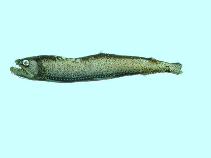
Épines dorsales (Total) : 0; Rayons mous dorsaux (Total) : 11 - 13; Épines anales: 0; Rayons mous anaux: 17 - 20. AC discontinuous, 2 or 3 photopores ranging from 5th to 8th displaced upward. Barbel distinctly longer than head, its stem speckled with melanophores. A prominent black band extending from ventral to lateral side of caudal peduncle. Attains 12 cm SL.
Body shape (shape guide): elongated; Cross section: compressed.
Found on continental slopes and sea mountains (Ref. 41299). Benthopelagic (Ref. 58302).
Cycle de vie et comportement reproducteur
Maturité | Reproduction | Frai | Œufs | Fécondité | Larves
Masuda, H., K. Amaoka, C. Araga, T. Uyeno and T. Yoshino, 1984. The fishes of the Japanese Archipelago. Vol. 1. Tokai University Press, Tokyo, Japan. 437 p. (text). (Ref. 559)
Statut dans la liste rouge de l'IUCN (Ref. 130435: Version 2025-2 (Global))
Menace pour l'homme
Harmless
Utilisations par l'homme
Outils
Articles particuliers
Télécharger en XML
Sources Internet
Estimations basées sur des modèles
Température préférée (Réf.
123201): 11.7 - 23.4, mean 17.4 °C (based on 430 cells).
Indice de diversité phylogénétique (Réf.
82804): PD
50 = 0.5000 [Uniqueness, from 0.5 = low to 2.0 = high].
Bayesian length-weight: a=0.00407 (0.00167 - 0.00996), b=3.05 (2.83 - 3.27), in cm total length, based on LWR estimates for this (Sub)family-body shape (Ref.
93245).
Niveau trophique (Réf.
69278): 3.8 ±0.6 se; based on size and trophs of closest relatives
Résilience (Réf.
120179): Haut, temps minimum de doublement de population inférieur à 15 mois (Preliminary K or Fecundity.).
Vulnérabilité de la pêche (Ref.
59153): Low vulnerability (10 of 100).
🛈