Elasmobranchii (Haie und Rochen) (sharks and rays) >
Myliobatiformes (Stingrays) >
Dasyatidae (Stingrays) > Dasyatinae
Etymology: Dasyatis: Greek, dasys = rough, dense (Ref. 45335).
More on author: Garman.
Taxonomic Remarks
This species is synonym of Dasyatis dipterura Jordan & Gilbert, 1880. See nomenclatural details in Eschmeyer (CofF ver. Oct. 2012: Ref. 92135). The species page will be removed.
Umwelt: Milieu / Klimazone / Tiefenbereich / Verbreitungsgebiet
Ökologie
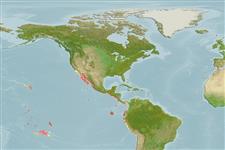
seewasser demersal; tiefenbereich 1 - 70 m (Ref. 37955), usually 1 - 17 m (Ref. 9254). Subtropical; 42°N - 19°S, 161°W - 70°W
Eastern Pacific: Hawaii and from California, USA to Peru.
Größe / Gewicht / Alter
Geschlechtsreife: Lm ? range ? - ? cm
Max length : 187 cm TL Männchen/unbestimmt; (Ref. 40637); common length : 120 cm TL Männchen/unbestimmt; (Ref. 9254); max. veröff. Gewicht: 46.3 kg (Ref. 40637)
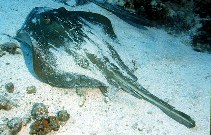
Found in bays, in sea grass beds, kelp beds, and near reefs on sand and mud bottoms (Ref. 12951). Digs in the sand to feed (Ref. 5227). Feeds on small fishes, crabs, clams, and other benthic invertebrates (Ref. 37955). Ovoviviparous (Ref. 50449). Venomous spine on tail.
Lebenszyklus und Paarungsverhalten
Geschlechtsreife | Fortpflanzung | Ablaichen | Eier | Fruchtbarkeit | Larven
Exhibit ovoviparity (aplacental viviparity), with embryos feeding initially on yolk, then receiving additional nourishment from the mother by indirect absorption of uterine fluid enriched with mucus, fat or protein through specialised structures (Ref. 50449). Distinct pairing with embrace (Ref. 205).
Nishida, K. and K. Nakaya, 1990. Taxonomy of the genus Dasyatis (Elasmobranchia, Dasyatidae) from the North Pacific. In: Pratt Jr., H. L., S. H. Gruber and T. Taniuchi (eds.): Elasmobranchs as living resources: advances in the biology, ecology, systematics, and the status of the fisheries. NOAA (National Oceanic and Atmospheric Administration) Tech. Rept. NMFS 90:327-346. (Ref. 7445)
IUCN Rote Liste Status (Ref. 130435: Version 2025-2 (Global))
Bedrohung für Menschen
Venomous
Nutzung durch Menschen
Fischereien: weniger kommerziell; Aquarium: Öffentliche Aquarien
Tools
Zusatzinformationen
Download XML
Internet Quellen
Schätzungen auf der Grundlage von Modellen
Bevorzugte Temperatur (Ref.
123201): 19.1 - 28.9, mean 24.2 °C (based on 317 cells).
Phylogenetischer Diversitätsindex (Ref.
82804): PD
50 = 0.5020 [Uniqueness, from 0.5 = low to 2.0 = high].
Bayesian length-weight: a=0.00447 (0.00189 - 0.01058), b=3.12 (2.92 - 3.32), in cm total length, based on LWR estimates for this (Sub)family-body shape (Ref.
93245).
Trophische Ebene (Ref.
69278): 3.8 ±0.60 se; based on food items.
Widerstandsfähigkeit (Ref.
120179): niedrig, Verdopplung der Population dauert 4,5 - 14 Jahre. (Assuming fecundity<100).
Anfälligkeit der Fischerei (Ref.
59153): Very high vulnerability (90 of 100).
🛈
Nährstoffe (Ref.
124155): Calcium = 8.57 [1.15, 169.73] mg/100g; Iron = 0.64 [0.06, 7.72] mg/100g; Protein = 21.3 [18.9, 23.9] %; Omega3 = 0.179 [0.059, 0.499] g/100g; Selenium = 25.8 [5.2, 131.9] μg/100g; VitaminA = 3.34 [0.29, 35.44] μg/100g; Zinc = 0.41 [0.03, 5.00] mg/100g (wet weight);