Ambiente: milieu / zona climática / intervalo de profundidade / gama de distribuição
Ecologia
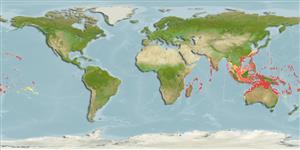
marinhas associadas(os) a recifes; intervalo de profundidade 4 - 100 m (Ref. 6390). Tropical; 30°N - 33°S, 33°E - 134°W (Ref. 5222)
Indo-Pacific: Kenya to Delagoa Bay, Mozambique, eastward to the Tuamoto Islands, north to the Ryukyu Islands, south to Queensland, Australia and including most islands of the Indian Ocean and of western and central Pacific. Unknown in the Red Sea and Persian Gulf. Misidentified as Plectropomus maculatus by some authors (Ref. 6448, 6892).
Comprimento na primeira maturidade / Tamanho / Peso / Idade
Maturidade: Lm ?, range 60 - ? cm
Max length : 125 cm TL macho/indeterminado; (Ref. 30573); common length : 84.0 cm SL macho/indeterminado; (Ref. 37816); peso máx. Publicado: 24.2 kg (Ref. 40637)
Espinhos dorsais (total) : 7 - 8; Raios dorsais moles (total) : 10 - 12; Espinhos anais: 3; Raios anais moles: 8.
Body shape (shape guide): fusiform / normal; Cross section: oval.
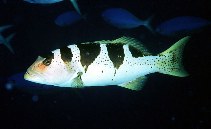
A voracious piscivore inhabiting coral-rich areas of lagoon and seaward reefs. Encountered most frequently in channels and outer shelf reefs. Migrate over short distances to spawn, forming large aggregations, maybe 1 or 2 per reef (Ref. 6390). Feeds mostly on fishes, and occasionally on crustaceans (Ref. 9710). The prey comprises a variety of large reef fishes, including groupers, and this diet of large fishes is responsible for the high concentrations of ciguatera toxins. Juveniles may mimic the pufferfish Canthigaster valentini. Usually wary (Ref. 9710). The young have a demersal existence in shallow water in reef habitats, especially around coral rubble (Ref. 27259). They feed on small fish and invertebrates such as crustaceans and squid (Ref. 27261). Eggs float just below the surface (Ref. 6390). The pelagic larvae are found in habitats similar to those of the adults (Ref. 27260). An excellent table fish (Ref. 6390).
Ciclo de vida e comportamento de acasalamento
Maturidade | Reprodução | Desova | Ovos | Fecundidade | Larvas
Heemstra, P.C. and J.E. Randall, 1993. FAO Species Catalogue. Vol. 16. Groupers of the world (family Serranidae, subfamily Epinephelinae). An annotated and illustrated catalogue of the grouper, rockcod, hind, coral grouper and lyretail species known to date. Rome: FAO. FAO Fish. Synop. 125(16):382 p. (Ref. 5222)
Categoria na Lista Vermelha da IUCN (Ref. 130435: Version 2025-2 (Global))
Ameaça para o homem
Reports of ciguatera poisoning (Ref. 1602)
Utilização humana
Pescarias: espécies comerciais; peixe desportivo: sim
Ferramentas
Relatórios especiais
Descarregue XML
Fontes da internet
Estimativas baseadas em modelos
Temperatura preferida (Ref.
123201): 25.5 - 28.9, mean 27.6 °C (based on 276 cells).
Índice de diversidade filogenética (Ref.
82804): PD
50 = 0.5039 [Uniqueness, from 0.5 = low to 2.0 = high].
Bayesian length-weight: a=0.00977 (0.00589 - 0.01620), b=3.07 (2.93 - 3.21), in cm total length, based on LWR estimates for this species & Genus-body shape (Ref.
93245).
Nível Trófico (Ref.
69278): 4.1 ±0.57 se; based on food items.
Resiliência (Ref.
120179): Médio, tempo mínimo de duplicação da população 1,4 - 4,4 anos (Preliminary K or Fecundity.).
Vulnerabilidade da pesca (Ref.
59153): High vulnerability (61 of 100).
🛈
Nutrientes (Ref.
124155): Calcium = 20.8 [13.2, 35.1] mg/100g; Iron = 0.482 [0.266, 0.777] mg/100g; Protein = 18.7 [16.9, 20.3] %; Omega3 = 0.133 [0.090, 0.206] g/100g; Selenium = 47.6 [28.5, 84.4] μg/100g; VitaminA = 76.1 [28.9, 230.2] μg/100g; Zinc = 0.698 [0.493, 0.988] mg/100g (wet weight);