Ambiente: milieu / zona climatica / distribuzione batimetrica / gamma di distribuzione
Ecologia
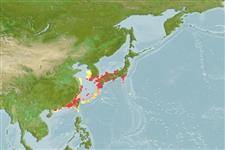
marino associati a barriera corallina; distribuzione batimetrica 0 - 30 m (Ref. 89707). Tropical; 37°N - 20°N, 112°E - 143°E (Ref. 5222)
Northwest Pacific: southern Japan, Korea, Taiwan, and China. Reports of the species (under the valid name or as Epinephelus fario) from the Indian Ocean are apparently based on misidentifications.
Lunghezza alla prima maturità / Dimensione / Peso / Età
Maturità: Lm ?, range 29 - ? cm
Max length : 50.0 cm TL maschio/sesso non determinato; (Ref. 89707)
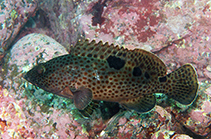
Spine dorsali (totale) : 11; Raggi dorsali molli (totale) : 16 - 17; Spine anali: 3; Raggi anali molli: 8. Preopercle rounded; serrae mostly hidden by skin; upper edge of operculum straight; nostrils small, subequal; maxilla reaches to or beyond vertical at rear edge of the eye. Area behind pectoral-fin tip with a patch of ctenoid scales in juveniles. Color is pale brown with small red or reddish brown spots. Fins darker, also covered with spots and often with a narrow white edge. A black blotch is at the base of the last 3 dorsal-fin spines, a smaller blotch at the base of the middle dorsal-fin rays, and a third on top of the caudal peduncle. Distinguished further by the following characteristics: body depth contained 2.7-3.3 times in SL; head length 2.4-2.6 times in SL; slightly convex interorbital area; small anterior and posterior nostrils, subequal; maxilla reaches to or past vertical at rear edge of eye; 2 rows of teeth on midlateral part of lower jaw (Ref. 89707).
Body shape (shape guide): fusiform / normal; Cross section: compressed.
Juveniles are common in tide pools and in shallow clear water around rocks and coral reefs; adults found in deeper water. Kuo et al. (1988, Ref. 6826) induced sex reversal and artificial spawning (referred to as 'Epinephelus fario').
Ciclo vitale e comportamento di accoppiamento
Maturità | Riproduzione | Deposizione | Uova | Fecondità | Larve
Heemstra, P.C. and J.E. Randall, 1993. FAO Species Catalogue. Vol. 16. Groupers of the world (family Serranidae, subfamily Epinephelinae). An annotated and illustrated catalogue of the grouper, rockcod, hind, coral grouper and lyretail species known to date. Rome: FAO. FAO Fish. Synop. 125(16):382 p. (Ref. 5222)
Stato della Lista Rossa IUCN (Ref. 130435: Version 2025-2 (Global))
Minaccia per l'uomo
Harmless
Usi umani
Pesca: commerciale; Acquacoltura: sperimentale
Strumenti
Rapporti speciali
Scarica XML
Fonti Internet
Stime basate su modelli
Temperatura preferita (Fonte Biblio.
123201): 18.7 - 25.4, mean 22 °C (based on 196 cells).
Indice di diversità filogenetica (Fonte Biblio.
82804): PD
50 = 0.5000 [Uniqueness, from 0.5 = low to 2.0 = high].
Bayesian length-weight: a=0.01148 (0.00555 - 0.02374), b=3.04 (2.87 - 3.21), in cm total length, based on LWR estimates for this Genus-body shape (Ref.
93245).
Livello trofico (Fonte Biblio.
69278): 4.0 ±0.66 se; based on food items.
Resilienza (Fonte Biblio.
120179): Medio, tempo minimo di raddoppiamento della popolazione 1.4 - 4.4 anni (Preliminary K or Fecundity.).
Vulnerabilità della pesca (Ref.
59153): Moderate vulnerability (40 of 100).
🛈
Nutrienti (Ref.
124155): Calcium = 29.3 [14.3, 61.4] mg/100g; Iron = 0.479 [0.264, 0.999] mg/100g; Protein = 18.6 [17.1, 20.0] %; Omega3 = 0.117 [0.074, 0.185] g/100g; Selenium = 29.1 [17.4, 52.6] μg/100g; VitaminA = 198 [54, 707] μg/100g; Zinc = 1.29 [0.89, 1.81] mg/100g (wet weight);