Milieu: milieu / Klimaatzone / Diepte / verspreidingsgebied
Ecologie
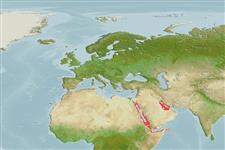
marien; brak water rifbewoner; diepte 1 - 30 m (Ref. 89707). Tropical; 31°N - 9°N, 32°E - 55°E (Ref. 5222)
Western Indian Ocean: known only from the Red Sea and Gulf of Aden (Ref. 5222). Reported from Somalia and Socotra (Yemen).
Grootte / Gewicht / Leeftijd
Maturiteit: Lm ? range ? - ? cm
Max length : 52.0 cm TL mannelijk / geslacht onbekend; (Ref. 9710); common length : 40.0 cm TL mannelijk / geslacht onbekend; (Ref. 5450)
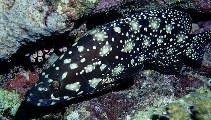
Dorsale stekels (totaal) : 11; Dorsale zachte stralen (totaal) : 14 - 16; Anale stekels: 3; Anale zachte stralen: 8 - 9. Body robust. Serrae at the angle of the preopercle slightly enlarged; the upper edge of the operculum strongly convex. Posterior nostril of adults vertically elongate. Very similar to E. ongus which has longer pectoral fins, and a narrow white margin with broad blackish submarginal band on the median fins, which are absent or poorly developed in E. summana. Generally dark olive-brown to dark brownish gray with large pale blotches (most larger than the eye) and numerous small white spots overlying this pattern. Fins covered with small white spots, except for pectoral fins where the white spots are confined to the base.
Body shape (shape guide): fusiform / normal; Cross section: compressed.
Occurs in shallow protected coral reefs and in lagoons or brackish-water environments (Ref. 5222). No published information on the biology of this species has been found (Ref. 5222). Sold fresh in local markets (Ref. 5222).
Levenscyclus en paargedrag
Maturiteit | Voortplanting | Paaien | Eieren | Fecunditeit | Larven
Heemstra, P.C. and J.E. Randall, 1993. FAO Species Catalogue. Vol. 16. Groupers of the world (family Serranidae, subfamily Epinephelinae). An annotated and illustrated catalogue of the grouper, rockcod, hind, coral grouper and lyretail species known to date. Rome: FAO. FAO Fish. Synop. 125(16):382 p. (Ref. 5222)
Status op de Rode Lijst van het IUCN (Ref. 130435: Version 2025-2 (Global))
Gevaar voor de mens
Harmless
Gebruik door de mens
Visserij: van minder commercieel belang
Tools
Speciale rapporten
Download XML
Internetbronnen
Schattingen op basis van modellen
Gewenste temperatuur (Ref.
123201): 25.1 - 29.3, mean 28.6 °C (based on 150 cells).
Fylogenetische diversiteitsindex (Ref.
82804): PD
50 = 0.5000 [Uniqueness, from 0.5 = low to 2.0 = high].
Bayesian length-weight: a=0.01148 (0.00555 - 0.02374), b=3.04 (2.87 - 3.21), in cm total length, based on LWR estimates for this Genus-body shape (Ref.
93245).
Trofisch niveau (Ref.
69278): 3.8 ±0.6 se; based on size and trophs of closest relatives
Weerstandsvermogen (Ref.
120179): Gemiddeld, minimale populatieverdubbelingstijd 1,4-4,4 jaar (Preliminary K or Fecundity.).
Kwetsbaarheid van de visserij (Ref.
59153): Moderate vulnerability (41 of 100).
🛈
Kwetsbaarheid voor het klimaat (Ref.
125649): Very high vulnerability (83 of 100).
🛈
Voedingsstoffen (Ref.
124155): Calcium = 28.8 [12.7, 60.3] mg/100g; Iron = 0.473 [0.253, 0.981] mg/100g; Protein = 18.8 [17.2, 20.3] %; Omega3 = 0.124 [0.076, 0.198] g/100g; Selenium = 28.4 [16.3, 51.7] μg/100g; VitaminA = 183 [46, 765] μg/100g; Zinc = 1.55 [1.04, 2.18] mg/100g (wet weight);