>
Perciformes/Serranoidei (Groupers) >
Epinephelidae (Groupers)
Etymology: Epinephelus: Greek, epinephelos = cloudy (Ref. 45335).
Eponymy: Dr Ferdinand Stoliczka (1838–1874) was an Austrian palaeontologist and zoologist who was born in Moravia (Czech Republic). [...] (Ref. 128868), visit book page.
More on author: Day.
Umwelt: Milieu / Klimazone / Tiefenbereich / Verbreitungsgebiet
Ökologie
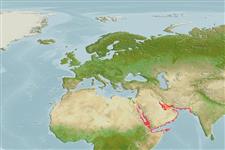
seewasser riff-verbunden; tiefenbereich 5 - 50 m (Ref. 89707). Tropical; 29°N - 10°N, 32°E - 68°E (Ref. 5222)
Western Indian Ocean: Red Sea (including Gulf of Suez) and northwestern Indian Ocean to the coast of Pakistan. Specimens examined include those from the Gulf of Oman. Not reported from the Gulf of Aqaba nor from Persian Gulf.
Größe / Gewicht / Alter
Geschlechtsreife: Lm ? range ? - ? cm
Max length : 38.0 cm TL Männchen/unbestimmt; (Ref. 89707); common length : 35.0 cm TL Männchen/unbestimmt; (Ref. 5450)
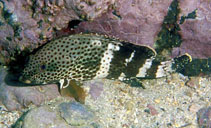
Rückenflossenstacheln (insgesamt) : 11; Rückenflossenweichstrahlen (insgesamt) : 16 - 18; Afterflossenstacheln: 3; Afterflossenweichstrahlen: 8. Body robust, preopercle with moderately enlarged serrae at its angle; upper edge of the operculum almost straight; nostrils subequal or posterior nostril slightly larger. Head and body yellowish gray, with dark orange-red or reddish brown spots except ventrally and posteriorly; dark gray bars running antero-ventrally from the base of the dorsal fin; a dark saddle blotch on the caudal peduncle. Fins generally yellowish brown; median fins with broad yellowish margin posteriorly (Ref. 89707).
Body shape (shape guide): fusiform / normal; Cross section: compressed.
Occurs on shallow sandy bottoms near small coral heads; it is not known from well-developed coral reefs (Ref. 5222). Nothing has been published on its biology nor its use in fisheries (Ref. 5222). Sold fresh in local markets (Ref. 5222).
Lebenszyklus und Paarungsverhalten
Geschlechtsreife | Fortpflanzung | Ablaichen | Eier | Fruchtbarkeit | Larven
Heemstra, P.C. and J.E. Randall, 1993. FAO Species Catalogue. Vol. 16. Groupers of the world (family Serranidae, subfamily Epinephelinae). An annotated and illustrated catalogue of the grouper, rockcod, hind, coral grouper and lyretail species known to date. Rome: FAO. FAO Fish. Synop. 125(16):382 p. (Ref. 5222)
IUCN Rote Liste Status (Ref. 130435: Version 2025-2 (Global))
Bedrohung für Menschen
Harmless
Nutzung durch Menschen
Fischereien: weniger kommerziell
Tools
Zusatzinformationen
Download XML
Internet Quellen
Schätzungen auf der Grundlage von Modellen
Bevorzugte Temperatur (Ref.
123201): 25.4 - 29.4, mean 27.9 °C (based on 142 cells).
Phylogenetischer Diversitätsindex (Ref.
82804): PD
50 = 0.5000 [Uniqueness, from 0.5 = low to 2.0 = high].
Bayesian length-weight: a=0.01148 (0.00555 - 0.02374), b=3.04 (2.87 - 3.21), in cm total length, based on LWR estimates for this Genus-body shape (Ref.
93245).
Trophische Ebene (Ref.
69278): 3.7 ±0.6 se; based on size and trophs of closest relatives
Widerstandsfähigkeit (Ref.
120179): mittel, Verdopplung der Population dauert 1,4 - 4,4 Jahre. (Preliminary K or Fecundity.).
Anfälligkeit der Fischerei (Ref.
59153): Low to moderate vulnerability (28 of 100).
🛈
Nährstoffe (Ref.
124155): Calcium = 34.4 [17.0, 70.1] mg/100g; Iron = 0.515 [0.282, 1.054] mg/100g; Protein = 18.5 [17.0, 19.9] %; Omega3 = 0.128 [0.082, 0.201] g/100g; Selenium = 30.8 [18.6, 53.3] μg/100g; VitaminA = 217 [61, 775] μg/100g; Zinc = 1.39 [0.96, 1.94] mg/100g (wet weight);