Umwelt: Milieu / Klimazone / Tiefenbereich / Verbreitungsgebiet
Ökologie
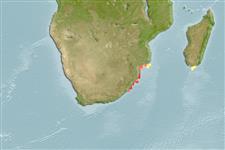
seewasser riff-verbunden; tiefenbereich 20 - 50 m (Ref. 4319). Subtropical; 25°S - 33°S, 30°E - 46°E (Ref. 5222)
Western Indian Ocean: known only from Madagascar, Natal in South Africa, and southern Mozambique.
Größe / Gewicht / Alter
Geschlechtsreife: Lm ? range ? - ? cm
Max length : 100.0 cm TL Männchen/unbestimmt; (Ref. 4319); max. veröff. Gewicht: 10.0 kg (Ref. 4319)
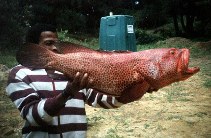
Rückenflossenstacheln (insgesamt) : 11; Rückenflossenweichstrahlen (insgesamt) : 15 - 16; Afterflossenstacheln: 3; Afterflossenweichstrahlen: 9. Distinguished by the following characteristics: body color dark reddish brown; head and body covered with small, irregular, close-set, dark red or reddish brown spots, pale interspaces forming irregular pale network pattern; 4 narrow, irregular, oblique, pale bars running down and forward on body; paired fins generally darker than body; body depth contained 3.1-3.5 times in SL; body width 1.7-2.0 times in depth; head length 2.3-2.4 times in SL; interorbital width 5.9-6.8 times in HL; concave interorbital area; rounded preopercle, finely serrate, shallow indentation just above angle; upper edge of operculum almost straight; inconspicuous opercular spines; posterior and anterior nostrils subequal; maxilla not reaching past eye; front of upper jaw with a pair of large, curved, fixed canines and a pair of similar but slightly smaller canines at front of lower jaw; lateral part of lower jaws with an outer row of 8-9 slightly smaller fixed canines and an inner row of smaller , more slender depressible teeth (Ref. 89707).
Body shape (shape guide): fusiform / normal; Cross section: compressed.
Appears to be a rare species, but it is of some importance to South African sport fishers along the northern coast of Natal. Coral reef-associated species inhabiting depths of 20-50 m (Ref. 89707). Feeds on fishes and invertebrates (Ref. 89707). Testes of a 61 cm SL specimen contained a central lumen and numerous 'brown bodies' along the lateral edges of the gonadal lamellae.
Lebenszyklus und Paarungsverhalten
Geschlechtsreife | Fortpflanzung | Ablaichen | Eier | Fruchtbarkeit | Larven
Heemstra, P.C. and J.E. Randall, 1993. FAO Species Catalogue. Vol. 16. Groupers of the world (family Serranidae, subfamily Epinephelinae). An annotated and illustrated catalogue of the grouper, rockcod, hind, coral grouper and lyretail species known to date. Rome: FAO. FAO Fish. Synop. 125(16):382 p. (Ref. 5222)
IUCN Rote Liste Status (Ref. 130435: Version 2025-2 (Global))
Bedrohung für Menschen
Harmless
Nutzung durch Menschen
Fischereien: kleinfischerei; Sportfisch: ja
Tools
Zusatzinformationen
Download XML
Internet Quellen
Schätzungen auf der Grundlage von Modellen
Bevorzugte Temperatur (Ref.
123201): 23.7 - 24.7, mean 24.2 °C (based on 4 cells).
Phylogenetischer Diversitätsindex (Ref.
82804): PD
50 = 0.5000 [Uniqueness, from 0.5 = low to 2.0 = high].
Bayesian length-weight: a=0.01148 (0.00555 - 0.02374), b=3.04 (2.87 - 3.21), in cm total length, based on LWR estimates for this Genus-body shape (Ref.
93245).
Trophische Ebene (Ref.
69278): 4.0 ±0.6 se; based on size and trophs of closest relatives
Widerstandsfähigkeit (Ref.
120179): sehr niedrig, Verdopplung der Population dauert mehr als 14 Jahre. (Preliminary K or Fecundity.).
Anfälligkeit der Fischerei (Ref.
59153): High vulnerability (60 of 100).
🛈