การจำแนกประเภท / ชื่อ
ชื่อสามัญ | ชื่อพ้อง | Catalog of Fishes(สกุล, ชนิด) | ITIS | CoL | WoRMS | Cloffa
สิ่งแวดล้อม : สิ่งแวดล้อม / เขตภูมิอากาศ / ระดับความลึก / ระยะการกระจายสินค้า
นิเวศวิทยา
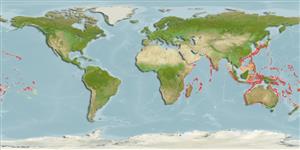
เกี่ยวกับทะเล,น้ำเค็ม สัตว์หน้าดินในเขตน้ำลึก; ระดับความลึก 150 - 300 m (Ref. 5222). Deep-water; 44°N - 39°S, 29°E - 136°W (Ref. 5222)
Indo-West Pacific: Somalia and South Africa to Japan, Australia and New Zealand. Except for Japan, China, and Korea, most distribution records for Epinephelus septemfasciatus are probably based on this species. Reported as Epinephelus compressus by Postel et al. (Ref. 6453).
ขนาด / น้ำหนัก / อายุ
วัยเจริญพันธุ์: Lm ? range ? - ? cm
Max length : 130 cm TL เพศผู้/กระเทย; (Ref. 4787); น้ำหนักสูงสุดที่มีการรายงาน: 80.0 kg (Ref. 4787); อายุสูงสุดที่ได้รายงาน: 43 ปี (Ref. 92312)
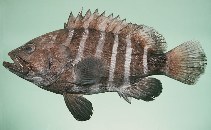
เงี่ยงครีบหลัง (รวม) : 11; ก้านครีบอ่อนที่หาง (รวม) : 14 - 15; เงี่ยงครีบก้น: 3; ก้านครีบอ่อนที่ก้น: 9. Distinguished by the following characteristics: body buff with 8 broad dark brown bars; blackish brown pelvic fins and distal half of the soft dorsal and anal fins; faint dark band from eye to the middle opercle spine; presence of blackish maxillary streak; minute melanophores covering gill rakers and gill arches; depth of body contained 2.2-2.7 times in SL; head length 2.4-2.5 times in SL; distinctly convex interorbital area, convex dorsal head profile; angular preopercle, enlarged serrae at angle; 0-3 small spines at lower edge of preopecle anterior to angle; distinctly serrate lower edge of subopercle and rear edge of interopercle; convex upper edge of operculum; posterior nostrils 2-3 times larger than anterior nostrils; maxilla reaches to below rear half of eye (Ref. 89707).
Body shape (shape guide): fusiform / normal; Cross section: compressed.
Probably occurs in rocky reefs. Its apparent rarity may be due to its preference for relatively deep water.
วงจรชีวิตและพฤติกรรมการผสมพันธุ์
วัยเจริญพันธุ์ | การสืบพันธุ์ | การวางไข่ | เซลสืบพันธ์ของเพศเมีย(ไข่) | ความดกของไข่ | ตัวอ่อน
Craig, M.T. and P.A. Hastings, 2007. A molecular phylogeny of the groupers of the subfamily Epinephelinae (Serranidae) with revised classification of the epinephelini. Ichthyol. Res. 54:1-17. (Ref. 83414)
สถานะบัญชีแดงของ IUCN (Ref. 130435: Version 2025-2 (Global))
ภัยคุกคามต่อมนุษย์
Reports of ciguatera poisoning (Ref. 30302)
การใช้ของมนุษย์
การประมง: มีการค้าเพียงเล็กน้อย
เครื่องมือ
รายงานพิเศษ
ดาวน์โหลด XML
แหล่งที่มาจากอินเตอร์เน็ต
การประมาณค่าตามแบบจำลอง
อุณหภูมิที่ต้องการ (อ้างอิง
123201): 13.4 - 21.2, mean 15.7 °C (based on 136 cells).
ดัชนีความหลากหลายทางวิวัฒนาการ (อ้างอิง
82804): PD
50 = 0.5000 [Uniqueness, from 0.5 = low to 2.0 = high].
Bayesian length-weight: a=0.01318 (0.00598 - 0.02904), b=3.04 (2.87 - 3.21), in cm total length, based on LWR estimates for this Genus-body shape (Ref.
93245).
ระดับชั้นอาหาร (อ้างอิง
69278): 4.0 ±0.7 se; based on size and trophs of closest relatives
Generation time: 10.0 ( na - na) years. Estimated as median ln(3)/K based on 2
growth studies.
ความสามารถในการกลับคืนสู่ปกติ (อ้างอิง
120179): ต่ำมาก, เวลาต่ำสุดที่จะทำให้ประชากรเพิ่มขึ้นเป็น 2 เท่าใช้เวลามากกว่า 14 ปี (Preliminary K or Fecundity.).
ความเสี่ยงต่อการตกปลา (Ref.
59153): High to very high vulnerability (68 of 100).
🛈
สารอาหาร (Ref.
124155): Calcium = 12.9 [6.0, 29.5] mg/100g; Iron = 0.31 [0.14, 0.67] mg/100g; Protein = 17.8 [16.0, 19.6] %; Omega3 = 0.353 [0.188, 0.660] g/100g; Selenium = 18.7 [8.2, 43.5] μg/100g; VitaminA = 8.75 [1.65, 45.73] μg/100g; Zinc = 0.27 [0.19, 0.41] mg/100g (wet weight);