Ambiente: milieu / zona climatica / distribuzione batimetrica / gamma di distribuzione
Ecologia
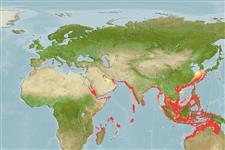
marino demersale; distribuzione batimetrica 20 - 240 m (Ref. 89707). Tropical; 33°N - 23°S, 35°W - 143°E (Ref. 5222)
Indo-West Pacific: Red Sea, Persian Gulf, Gulf of Oman, Pakistan, India, Viet Nam, Hong Kong, China, Korea, southern Japan, Taiwan, and northwest Australia. Unknown from the east coast of Africa, islands of the Indian Ocean, Indonesia, Philippines, or New Guinea.
Lunghezza alla prima maturità / Dimensione / Peso / Età
Maturità: Lm ?, range 86 - ? cm
Max length : 137 cm SL maschio/sesso non determinato; (Ref. 4787); common length : 70.0 cm TL maschio/sesso non determinato; (Ref. 5450); peso massimo pubblicato: 58.6 kg (Ref. 4787)
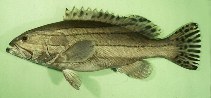
Spine dorsali (totale) : 11; Raggi dorsali molli (totale) : 12 - 14; Spine anali: 3; Raggi anali molli: 8. Distinguished by the following characteristics: juveniles are lavender-grey or pale brownish, shading to white ventrally; 2 black-edged white longitudinal bands, upper band extending from above the eye to the anterior dorsal-fin rays, and the lower band from below the eye to the lower band from below the eye to the lower caudal-fin rays; black spots and streaks on dorsal and caudal fins; head and body of large adults, uniformly grey; body depth contained 2.9-3.4 times in SL; head length 2.3-2.6 times in SL; convex interorbital area, convex dorsal head profile; angular preopercle, 3-7 distinctly enlarged serrae at angle; distinctly convex upper edge of operculum; subequal anterior and posterior nostrils; maxilla reaches past vertical at rear edge of eye; 2-3 rows of teeth on midlateral part of lower jaw (Ref. 89707).
Body shape (shape guide): fusiform / normal; Cross section: compressed.
Seems to prefer continental localities; bottoms of low relief. Large individuals are taken on coarse sand or rocky areas, while the smaller ones live on silty-sand and muddy bottom. Also caught throughout the year by long-liners (Ref. 5222).
Ciclo vitale e comportamento di accoppiamento
Maturità | Riproduzione | Deposizione | Uova | Fecondità | Larve
Heemstra, P.C. and J.E. Randall, 1993. FAO Species Catalogue. Vol. 16. Groupers of the world (family Serranidae, subfamily Epinephelinae). An annotated and illustrated catalogue of the grouper, rockcod, hind, coral grouper and lyretail species known to date. Rome: FAO. FAO Fish. Synop. 125(16):382 p. (Ref. 5222)
Stato della Lista Rossa IUCN (Ref. 130435: Version 2025-2 (Global))
Minaccia per l'uomo
Harmless
Usi umani
Pesca: commerciale
Strumenti
Rapporti speciali
Scarica XML
Fonti Internet
Stime basate su modelli
Temperatura preferita (Fonte Biblio.
123201): 19.5 - 28.2, mean 26 °C (based on 902 cells).
Indice di diversità filogenetica (Fonte Biblio.
82804): PD
50 = 0.5000 [Uniqueness, from 0.5 = low to 2.0 = high].
Bayesian length-weight: a=0.01230 (0.00773 - 0.01958), b=3.04 (2.91 - 3.17), in cm total length, based on LWR estimates for this species & Genus-body shape (Ref.
93245).
Livello trofico (Fonte Biblio.
69278): 4.0 ±0.65 se; based on food items.
Generation time: 11.0 ( na - na) years. Estimated as median ln(3)/K based on 2
growth studies.
Resilienza (Fonte Biblio.
120179): Basso, tempo minimo di raddoppiamento della popolazione 4.5 - 14 anni (tmax=30).
Vulnerabilità della pesca (Ref.
59153): Very high vulnerability (77 of 100).
🛈
Nutrienti (Ref.
124155): Calcium = 54.2 [22.6, 119.0] mg/100g; Iron = 0.854 [0.376, 2.031] mg/100g; Protein = 18.1 [16.5, 19.6] %; Omega3 = 0.206 [0.104, 0.397] g/100g; Selenium = 97.8 [46.3, 245.2] μg/100g; VitaminA = 21 [5, 85] μg/100g; Zinc = 0.873 [0.536, 1.456] mg/100g (wet weight);