Environnement : milieu / zone climatique / profondeur / gamme de distribution
Écologie
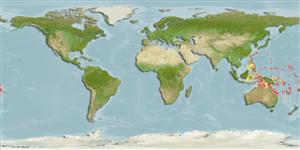
marin récifal; profondeur 1 - 37 m (Ref. 86942). Tropical; 28°N - 34°S, 115°E - 174°W (Ref. 5222)
Western Pacific: Ryukyu Islands south to Lord Howe Island and east to Howland Island and Samoa. Often misidentified as Epinephelus macrospilos or Epinephelus corallicola.
Longueur à la première maturité / Taille / Poids / Âge
Maturité: Lm ?, range 24 - ? cm
Max length : 55.0 cm TL mâle / non sexé; (Ref. 48635)
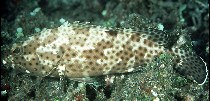
Épines dorsales (Total) : 11; Rayons mous dorsaux (Total) : 15 - 17; Épines anales: 3; Rayons mous anaux: 8. Distinguished by the following characteristics: head and body pale grey or brownish grey, covered with small brownish black spots with diffuse edges, separated from adjacent spots by spaces equal to or greater than width of the spots; body with black saddle blotch , smaller black saddle blotch on the caudal peduncle; dusky margins of the soft dorsal, caudal and anal fins, with white line along edge; median and pelvic fins with dark spots; dusky pectoral fins with few dark spots basally; body depth contained 2.9-3.3 times in SL; HL 2.2-2.5 times in SL; flat interorbital area, convex dorsal head profile; rounded preopercle, slightly enlarged serrae at angle; maxilla reaches past vertical at rear edge of eye; 2-4 rows of teeth on the midlateral part of lower jaw; pyloric caeca 13 (Ref. 89707).
Body shape (shape guide): fusiform / normal; Cross section: compressed.
Usually found over rocky areas or on coral reefs. Feeds on fishes and crustaceans (shrimps and crab) with occasional molluscs or worms (Ref. 89707). Nothing has been published on its biology. Appears to be very rare and therefore of little commercial importance. In Hong Kong live fish markets (Ref. 27253).
Cycle de vie et comportement reproducteur
Maturité | Reproduction | Frai | Œufs | Fécondité | Larves
Heemstra, P.C. and J.E. Randall, 1993. FAO Species Catalogue. Vol. 16. Groupers of the world (family Serranidae, subfamily Epinephelinae). An annotated and illustrated catalogue of the grouper, rockcod, hind, coral grouper and lyretail species known to date. Rome: FAO. FAO Fish. Synop. 125(16):382 p. (Ref. 5222)
Statut dans la liste rouge de l'IUCN (Ref. 130435: Version 2025-2 (Global))
Menace pour l'homme
Harmless
Utilisations par l'homme
Pêcheries: pêcheries vivrières; Aquarium: Aquariums publics
Outils
Articles particuliers
Télécharger en XML
Sources Internet
Estimations basées sur des modèles
Température préférée (Réf.
123201): 24.7 - 28.9, mean 27.5 °C (based on 268 cells).
Indice de diversité phylogénétique (Réf.
82804): PD
50 = 0.5000 [Uniqueness, from 0.5 = low to 2.0 = high].
Bayesian length-weight: a=0.01148 (0.00767 - 0.01720), b=3.05 (2.93 - 3.17), in cm total length, based on LWR estimates for this species & Genus-body shape (Ref.
93245).
Niveau trophique (Réf.
69278): 4.0 ±0.64 se; based on food items.
Résilience (Réf.
120179): Milieu, temps minimum de doublement de population : 1,4 à 4,4 années (Preliminary K or Fecundity.).
Vulnérabilité de la pêche (Ref.
59153): Moderate vulnerability (42 of 100).
🛈
Nutriments (Ref.
124155): Calcium = 27.1 [13.3, 57.2] mg/100g; Iron = 0.468 [0.256, 0.969] mg/100g; Protein = 18.6 [17.1, 20.0] %; Omega3 = 0.117 [0.074, 0.184] g/100g; Selenium = 31.2 [18.6, 55.7] μg/100g; VitaminA = 189 [53, 677] μg/100g; Zinc = 1.26 [0.87, 1.77] mg/100g (wet weight);