>
Perciformes/Serranoidei (Groupers) >
Epinephelidae (Groupers)
Etymology: Epinephelus: Greek, epinephelos = cloudy (Ref. 45335).
Eponymy: Dr Gabriella Bianchi is a marine biologist who has worked at the Norwegian Institute of Marine Research and was Coordinator, Marine and Inland Fisheries Service, at the Fisheries and Aquaculture Department of the Food & Agriculture Organization of [...] (Ref. 128868), visit book page.
More on authors: Randall & Heemstra.
Umwelt: Milieu / Klimazone / Tiefenbereich / Verbreitungsgebiet
Ökologie
seewasser demersal; tiefenbereich 6 - 88 m (Ref. 30573). Tropical; 20°N - 11°N, 51°E - 59°E (Ref. 5222)
Western Indian Ocean: Somalia to Oman.
Größe / Gewicht / Alter
Geschlechtsreife: Lm ? range ? - ? cm
Max length : 52.0 cm TL Männchen/unbestimmt; (Ref. 11441)
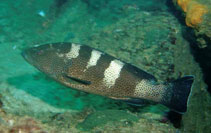
Rückenflossenstacheln (insgesamt) : 11; Rückenflossenweichstrahlen (insgesamt) : 14 - 15; Afterflossenstacheln: 3; Afterflossenweichstrahlen: 8. Distinguished by the following characteristics: head and body pale brownish gray, densely covered with tiny close-set dark orange-brown spots; median and paired fins spotted like body; caudal, soft dorsal and anal fins with white edge and a submarginal blackish zone; depth of body 3.2-3.6 times in SL; head length 2.4-2.6 times in SL; flat to slightly convex interorbital area, dorsal head profile with slight indentation above nostrils; preopercular angular, with enlarged serrae at the angle and a shallow notch just above the angle; upper edge of operculum straight; posterior nostril slightly larger than anterior; maxilla reaches vertical at rear edge of eye; ventral edge of maxilla with a low step-like bend one orbit diameter from rear end of bone; 2 rows of teeth on midlateral part of lower jaw; lateral body scales ctenoid, with numerous auxiliary scales; pyloric caeca about 76 (Ref. 89707).
Body shape (shape guide): fusiform / normal; Cross section: compressed.
Found over rocky bottoms (Ref. 30573); reef-associated species. Juveniles/subadults inhabits shallow waters with high coral cover. Feeds on fishes and invertebrates (Ref. 89707). Minimum depth from Ref. 58018.
Lebenszyklus und Paarungsverhalten
Geschlechtsreife | Fortpflanzung | Ablaichen | Eier | Fruchtbarkeit | Larven
Heemstra, P.C. and J.E. Randall, 1993. FAO Species Catalogue. Vol. 16. Groupers of the world (family Serranidae, subfamily Epinephelinae). An annotated and illustrated catalogue of the grouper, rockcod, hind, coral grouper and lyretail species known to date. Rome: FAO. FAO Fish. Synop. 125(16):382 p. (Ref. 5222)
IUCN Rote Liste Status (Ref. 130435: Version 2025-2 (Global))
Bedrohung für Menschen
Harmless
Nutzung durch Menschen
Fischereien: weniger kommerziell
Tools
Zusatzinformationen
Download XML
Internet Quellen
Schätzungen auf der Grundlage von Modellen
Phylogenetischer Diversitätsindex (Ref.
82804): PD
50 = 0.5000 [Uniqueness, from 0.5 = low to 2.0 = high].
Bayesian length-weight: a=0.01148 (0.00555 - 0.02374), b=3.04 (2.87 - 3.21), in cm total length, based on LWR estimates for this Genus-body shape (Ref.
93245).
Trophische Ebene (Ref.
69278): 3.8 ±0.6 se; based on size and trophs of closest relatives
Widerstandsfähigkeit (Ref.
120179): mittel, Verdopplung der Population dauert 1,4 - 4,4 Jahre. (Preliminary K or Fecundity.).
Anfälligkeit der Fischerei (Ref.
59153): Moderate vulnerability (41 of 100).
🛈