Elasmobranchii (tubarões e raias) (sharks and rays) >
Squatiniformes (Angel sharks) >
Squatinidae (Angel sharks)
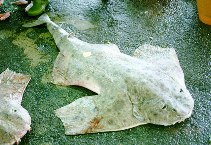
Etymology: Squatina: Latin for skate, which angel sharks superficially resemble, presumably tautonymous with Squalus squatina Linnaeus 1758 (no species mentioned) (See ETYFish); nebulosa: Latin for cloudy or dark, referring to its brown-black marbled coloration (See ETYFish).
More on author: Regan.
Ambiente: milieu / zona climática / intervalo de profundidade / gama de distribuição
Ecologia
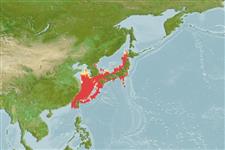
marinhas demersal; intervalo de profundidade 0 - 200 m (Ref. 54907). Deep-water; 47°N - 22°N, 119°E - 142°E (Ref. 54907)
Northwest Pacific: southeastern Sea of Japan to Taiwan, including Japan, Korea, China. Reported from the northern shelf of the South China Sea (Ref. 12082).
Tamanho / Peso / Idade
Maturidade: Lm ? range ? - ? cm
Max length : 163.0 cm TL (female)
Found on the continental shelves. Ovoviviparous (Ref. 50449).
Ciclo de vida e comportamento de acasalamento
Maturidade | Reprodução | Desova | Ovos | Fecundidade | Larvas
Ovoviviparous, embryos feed solely on yolk (Ref. 50449).
Compagno, L.J.V., 1984. FAO Species Catalogue. Vol. 4. Sharks of the world. An annotated and illustrated catalogue of shark species known to date. Part 1 - Hexanchiformes to Lamniformes. FAO Fish. Synop. 125(4/1):1-249. Rome, FAO. (Ref. 247)
Categoria na Lista Vermelha da IUCN (Ref. 130435: Version 2025-2 (Global))
Ameaça para o homem
Traumatogenic
Utilização humana
Ferramentas
Relatórios especiais
Descarregue XML
Fontes da internet
Estimativas baseadas em modelos
Temperatura preferida (Ref.
123201): 11.8 - 23.5, mean 18.1 °C (based on 106 cells).
Índice de diversidade filogenética (Ref.
82804): PD
50 = 0.5000 [Uniqueness, from 0.5 = low to 2.0 = high].
Bayesian length-weight: a=0.00661 (0.00287 - 0.01523), b=3.07 (2.88 - 3.26), in cm total length, based on LWR estimates for this Genus-body shape (Ref.
93245).
Nível Trófico (Ref.
69278): 4.1 ±0.6 se; based on size and trophs of closest relatives
Resiliência (Ref.
120179): Baixo, tempo mínimo de duplicação da população 4,5 - 14 anos (Fec assumed to be <100).
Vulnerabilidade da pesca (Ref.
59153): Very high vulnerability (90 of 100).
🛈