>
Perciformes/Serranoidei (Groupers) >
Epinephelidae (Groupers)
Etymology: Epinephelus: Greek, epinephelos = cloudy (Ref. 45335).
Eponymy: Eduard C F Dämle, also known as Dämel or Daemel (1821–1900), was a German entomologist, and a collector and dealer in natural history specimens. [...] (Ref. 128868), visit book page.
More on author: Günther.
Environnement : milieu / zone climatique / profondeur / gamme de distribution
Écologie
marin récifal; profondeur ? - 50 m (Ref. 5222). Subtropical; 25°S - 43°S, 136°E - 177°W (Ref. 5222)
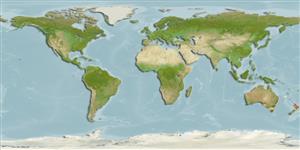
Southwest Pacific: Australia, Lord Howe Island, Norfolk Island, Kermadec Islands and New Zealand (North Island and Poor Knights Island). The Australian range extends from southern Queensland to Kangaroo Island off South Australia; also reported from the Bass Strait.
Taille / Poids / Âge
Maturité: Lm ? range ? - ? cm
Max length : 200 cm TL mâle / non sexé; (Ref. 9710); poids max. publié: 68.0 kg (Ref. 4787)
Épines dorsales (Total) : 9; Rayons mous dorsaux (Total) : 14; Épines anales: 3; Rayons mous anaux: 8.
Body shape (shape guide): fusiform / normal; Cross section: compressed.
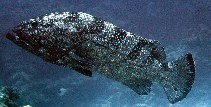
Found on rocky substrata from near shore to at least 50 m. It is an aggressive territorial species that may occupy a particular cave for life. Small individuals feed on crabs and small fishes. Sexual transition reported to occur at 100-110 cm (Ref. 6787). Large individuals are often attracted by divers (Ref. 9710). An esteemed food fish avidly sought by anglers and spear fishermen.
Cycle de vie et comportement reproducteur
Maturité | Reproduction | Frai | Œufs | Fécondité | Larves
Heemstra, P.C. and J.E. Randall, 1993. FAO Species Catalogue. Vol. 16. Groupers of the world (family Serranidae, subfamily Epinephelinae). An annotated and illustrated catalogue of the grouper, rockcod, hind, coral grouper and lyretail species known to date. Rome: FAO. FAO Fish. Synop. 125(16):382 p. (Ref. 5222)
Statut dans la liste rouge de l'IUCN (Ref. 130435: Version 2025-2 (Global))
Menace pour l'homme
Harmless
Utilisations par l'homme
Pêcheries: pêcheries vivrières; pêche sportive: oui
Outils
Articles particuliers
Télécharger en XML
Sources Internet
Estimations basées sur des modèles
Température préférée (Réf.
123201): 16.4 - 24.3, mean 17.9 °C (based on 56 cells).
Indice de diversité phylogénétique (Réf.
82804): PD
50 = 0.5000 [Uniqueness, from 0.5 = low to 2.0 = high].
Bayesian length-weight: a=0.01148 (0.00555 - 0.02374), b=3.04 (2.87 - 3.21), in cm total length, based on LWR estimates for this Genus-body shape (Ref.
93245).
Niveau trophique (Réf.
69278): 4.0 ±0.70 se; based on food items.
Résilience (Réf.
120179): Très faible, temps minimum de doublement de population supérieur à 14 ans (Preliminary K or Fecundity.).
Vulnérabilité de la pêche (Ref.
59153): Very high vulnerability (90 of 100).
🛈
Nutriments (Ref.
124155): Calcium = 7.69 [2.83, 18.19] mg/100g; Iron = 0.356 [0.177, 0.770] mg/100g; Protein = 19.4 [17.8, 20.9] %; Omega3 = 0.139 [0.071, 0.276] g/100g; Selenium = 23.2 [10.1, 51.6] μg/100g; VitaminA = 61.1 [13.9, 265.1] μg/100g; Zinc = 0.665 [0.427, 1.019] mg/100g (wet weight);