>
Perciformes/Serranoidei (Groupers) >
Epinephelidae (Groupers)
Etymology: Epinephelus: Greek, epinephelos = cloudy (Ref. 45335).
Eponymy: Dr Pieter Bleeker (1819–1878) was an ichthyologist and army surgeon commissioned (1841) by the Dutch East India Company. [...] (Ref. 128868), visit book page.
More on author: Vaillant.
Environnement : milieu / zone climatique / profondeur / gamme de distribution
Écologie
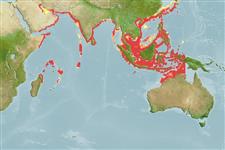
marin démersal; profondeur 30 - 105 m (Ref. 89707). Tropical; 36°N - 17°S, 48°E - 153°E
Indo-West Pacific: Persian Gulf to Taiwan, Indonesia and the northern coast of Australia. Not known from Japan, but may occur here. It has not been found at any islands of Micronesia nor Polynesia.
Longueur à la première maturité / Taille / Poids / Âge
Maturité: Lm 36.0, range 42 - ? cm
Max length : 76.0 cm TL mâle / non sexé; (Ref. 2852)
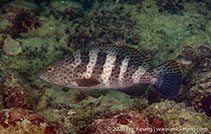
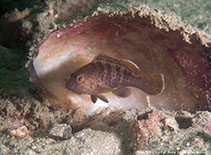
Épines dorsales (Total) : 11; Rayons mous dorsaux (Total) : 16 - 18; Épines anales: 3; Rayons mous anaux: 8 - 9. Recognized by the bluish lower half of the caudal fin and the lack of spots there compared to the upper half (Ref. 48635); characterized further by: generally brown color; head, body and fins with red to dark brown spots; body scales ctenoid, except cycloid scales on nape, thorax and ventrally on abdomen; body with auxiliary scales; elongate body, greatest depth 3.0-3.5 in SL; truncate to slightly rounded caudal fin; short pelvic fins, 1.9-2.4 in head length (Ref. 90102); head length 2.4-2.7 times in standard length; interorbital area flat to slightly convex; preopercle angle with 2-9 enlarged serrae, adults with a notch above angle; straight upper edge of operculum; scaly maxilla, reaching to or beyond vertical at rear edge of eye; 2 rows of subequal teeth on midlateral part of lower jaw (Ref. 089707).
Body shape (shape guide): fusiform / normal; Cross section: compressed.
Occur on shallow banks, but is not known from well-developed coral reefs (Ref. 27253) and adjacent soft substrate in depths of 30-105 m (Ref. 089707). Also found in silty coastal reefs and estuaries. Solitary (Ref 90102). Benthic (Ref. 75154). In Hong Kong live fish markets (Ref. 27253). Usually taken by trawling in 30-45 m or by hand-lining over rocky banks; not found from coral reefs (Ref. 11441).
Cycle de vie et comportement reproducteur
Maturité | Reproduction | Frai | Œufs | Fécondité | Larves
Heemstra, P.C. and J.E. Randall, 1993. FAO Species Catalogue. Vol. 16. Groupers of the world (family Serranidae, subfamily Epinephelinae). An annotated and illustrated catalogue of the grouper, rockcod, hind, coral grouper and lyretail species known to date. Rome: FAO. FAO Fish. Synop. 125(16):382 p. (Ref. 5222)
Statut dans la liste rouge de l'IUCN (Ref. 130435: Version 2025-2 (Global))
Menace pour l'homme
Harmless
Utilisations par l'homme
Pêcheries: intérêt commercial mineur; Aquaculture: commercial
Outils
Articles particuliers
Télécharger en XML
Sources Internet
Estimations basées sur des modèles
Température préférée (Réf.
123201): 23.2 - 28.4, mean 27.4 °C (based on 472 cells).
Indice de diversité phylogénétique (Réf.
82804): PD
50 = 0.5000 [Uniqueness, from 0.5 = low to 2.0 = high].
Bayesian length-weight: a=0.01259 (0.00798 - 0.01986), b=3.06 (2.93 - 3.19), in cm total length, based on LWR estimates for this species & Genus-body shape (Ref.
93245).
Niveau trophique (Réf.
69278): 3.9 ±0.6 se; based on size and trophs of closest relatives
Generation time: 8.8 ( na - na) years. Estimated as median ln(3)/K based on 1
growth studies.
Résilience (Réf.
120179): Faible, temps minimum de doublement de population : 4,5 à 14 années (tmax=24).
Vulnérabilité de la pêche (Ref.
59153): High vulnerability (60 of 100).
🛈
Nutriments (Ref.
124155): Calcium = 63.8 [27.4, 146.6] mg/100g; Iron = 0.814 [0.386, 1.864] mg/100g; Protein = 17.7 [16.0, 19.2] %; Omega3 = 0.191 [0.099, 0.351] g/100g; Selenium = 65.2 [30.8, 150.7] μg/100g; VitaminA = 44.3 [10.7, 180.9] μg/100g; Zinc = 1.21 [0.77, 1.97] mg/100g (wet weight);