Entorno: milieu / zona climática / rango de profundidad / gama de distribución
Ecología
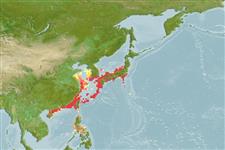
marino asociado a arrecife; rango de profundidad 10 - 50 m (Ref. 5222). Tropical; 39°N - 12°N, 110°E - 143°E (Ref. 5222)
Northwest Pacific: Korea, Japan, Taiwan, China, Viet Nam, and islands in the South China Sea.
Longitud en la primera madurez / Tamaño / Peso / Edad
Madurez: Lm ?, range 16 - ? cm
Max length : 60.0 cm TL macho / no sexado; (Ref. 5222); common length : 30.0 cm TL macho / no sexado; (Ref. 9137)
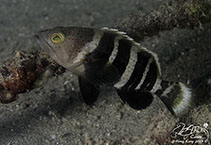
Espinas dorsales (total) : 11; Radios blandos dorsales (total) : 15 - 16; Espinas anales: 3; Radios blandos anales: 8. Distinguished by the following characteristics: head and body pale greyish brown dorsally, usually golden yellow ventrally; 4 broad dark bars on the dorsal part of the body, one on caudal peduncle and another often visible on nape; numerous small yellow spots on head and body; body and median fins with small greyish white spots; soft dorsal and caudal fins and sometimes the anal fin, with prominent yellow margin; dusky yellow paired fins; yellow mustache in the maxillary groove; body depth 2.7-3.3 times in SL; head length 2.3-2.6 times in SL; convex interorbital area; strongly convex dorsal head profile; subangular preopercle, 2-5 strong spines at the angle; upper edge of operculum straight, uppermost spine rudimentary; maxilla reaches about to vertical at rear edge of eye; 2 rows of small, subequal teeth on midlateral part of lower jaw; caudal fin convex; lateral body scales distinctly ctenoid, with auxiliary scales in fish larger than 30 cm SL; pyloric caeca 12, in 3 bundles (Ref. 089707).
Body shape (shape guide): fusiform / normal.
Occurs in rocky areas as well as on sandy-mud bottoms. Juveniles are common in tide pools. In captivity, the species is aggressive, chasing and biting other species, especially members of its own species. Protogynous hermaphrodite (Ref. 5222). Artificial fertilization of eggs was done and the longest survival time for the larvae was 15 days (Ref. 6780). In Hong Kong live fish markets (Ref. 27253).
Heemstra, P.C. and J.E. Randall, 1993. FAO Species Catalogue. Vol. 16. Groupers of the world (family Serranidae, subfamily Epinephelinae). An annotated and illustrated catalogue of the grouper, rockcod, hind, coral grouper and lyretail species known to date. Rome: FAO. FAO Fish. Synop. 125(16):382 p. (Ref. 5222)
Situación en la Lista Roja de la UICN (Ref. 130435: Version 2025-2 (Global))
Amenaza para el ser humano
Harmless
Usos humanos
Pesquerías: comercial; Acuicultura: comercial
Herramientas
Informes especiales
Descargar XML
Fuentes de Internet
Estimaciones basadas en modelos
Temperatura preferida (Referencia
123201): 16.2 - 25.6, mean 22.5 °C (based on 74 cells).
Índice de diversidad filogenética (Referencia
82804): PD
50 = 0.5000 [Uniqueness, from 0.5 = low to 2.0 = high].
Bayesian length-weight: a=0.01096 (0.00635 - 0.01893), b=3.04 (2.90 - 3.18), in cm total length, based on LWR estimates for this species & Genus-body shape (Ref.
93245).
Nivel trófico (Referencia
69278): 3.6 ±0.55 se; based on food items.
Resiliencia (Referencia
120179): Alto, población duplicada en un tiempo mínimo inferior a 15 meses (Fecundity = 24,329).
Vulnerabilidad pesquera (Ref.
59153): Moderate vulnerability (44 of 100).
🛈
Nutrientes (Ref.
124155): Calcium = 25.4 [12.5, 56.5] mg/100g; Iron = 0.474 [0.258, 0.967] mg/100g; Protein = 18.4 [16.9, 19.8] %; Omega3 = 0.113 [0.070, 0.180] g/100g; Selenium = 34.9 [21.0, 62.3] μg/100g; VitaminA = 167 [47, 594] μg/100g; Zinc = 1.34 [0.94, 1.87] mg/100g (wet weight);