>
Tetraodontiformes (Puffers and filefishes) >
Balistidae (Triggerfishes)
Etymology: Balistes: Latin, balista, -ae = crossbowman. In Greek, ballo = to throw (Ref. 45335); capriscus: Specific name 'capriscus' meaning a small goat; probably referring to its 'face' which looks like a small goat (to be confirmed).
More on author: Gmelin.
Lingkungan: lingkungan / zona iklim / kisaran kedalaman / jangkauan distribusi
Ekologi
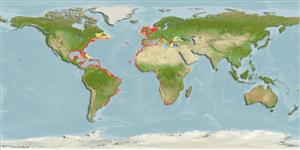
laut berasosiasi dengan karang; kisaran kedalaman 0 - 100 m (Ref. 7348), usually 0 - 55 m (Ref. 55172). Tropical; 58°N - 37°S, 98°W - 36°E
Western and Eastern Atlantic:
Panjang pada saat jatuh tempo pertama / Ukuran / Berat / umur
Kematangan: Lm 17.0, range 13 - 29.7 cm
Max length : 66.0 cm TL jantan/; (Ref. 127374); common length : 44.0 cm TL jantan/; (Ref. 47377); Berat maksimum terpublikasi: 6.2 kg (Ref. 40637); Umur maksimum dilaporkan: 15 Tahun (Ref. 107826)
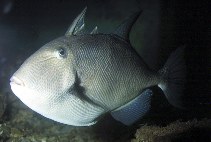
Duri punggung (Keseluruhan (total)) : 3; duri punggung lunak (Keseluruhan (total)) : 26 - 29; Duri dubur: 0; Sirip dubur lunak: 23 - 26. Tall, with a small mouth and plate like scales (Ref. 35388). Three faint irregular broad dark bars on body; a narrow pale transverse band on chin; small light blue spots on upper half of body and median fins, and irregular short lines ventrally (Ref. 13442).
Body shape (shape guide): short and / or deep.
Inhabits bays, harbors, lagoons, and seaward reefs (Ref. 9710). May drift with young at surface among Sargassum (Ref. 9710). Usually solitary or in small groups (Ref. 9710). Feeds on benthic invertebrates like mollusks and crustaceans (Ref. 4727). Oviparous (Ref. 205). Consumed mostly fresh, smoked, and dried salted. The flesh is of excellent quality. Because it is resistant to capture, it proliferates and competes for food with other species (Ref. 5377).
Adults guard the embryos nested in sand which hatched in about two days (Ref. 9778).
Smith-Vaniz, W.F., B.B. Collette and B.E. Luckhurst, 1999. Fishes of Bermuda: history, zoogeography, annotated checklist, and identification keys. American Society of Ichthyologists and Herpetologists Special Publication No. 4. 424 p. (Ref. 35505)
Status IUCN Red List (Ref. 130435: Version 2025-2 (Global))
ancaman kepada manusia
Reports of ciguatera poisoning (Ref. 30911)
penggunaan manusia
Perikanan: komersial; Ikan buruan: ya; Akuarium: Akuarium publik
Alat, peralatan
laporan khas
muat turun XML
Sumber internet
Estimasi berdasarkan model
Suhu yang disukai (Acuan
123201): 9 - 26.2, mean 17.8 °C (based on 1432 cells).
Indeks keanekaragaman filogenetik (Acuan
82804): PD
50 = 0.5312 [Uniqueness, from 0.5 = low to 2.0 = high].
Bayesian length-weight: a=0.02239 (0.01919 - 0.02612), b=2.88 (2.83 - 2.93), in cm total length, based on LWR estimates for this species (Ref.
93245).
Tingkat Trofik (Acuan
69278): 4.1 ±0.2 se; based on diet studies.
Generation time: 4.0 (2.6 - 4.8) years. Estimated as median ln(3)/K based on 20
growth studies.
Daya lenting (Acuan
120179): sedang, Waktu penggandaan populasi minimum 1.4 - 4.4 tahun (K=0.18-0.43; tm=1).
Prior r = 0.37, 95% CL = 0.25 - 0.56, Based on 1 full stock assessment.
Kerentanan Penangkapan Ikan (Ref.
59153): Moderate to high vulnerability (46 of 100).
🛈
Kerentanan Iklim (Ref.
125649): Low to moderate vulnerability (32 of 100).
🛈
Nutrisi (Ref.
124155): Calcium = 17.4 [6.5, 68.9] mg/100g; Iron = 0.507 [0.242, 1.275] mg/100g; Protein = 19.7 [18.6, 20.8] %; Omega3 = 0.212 [0.146, 0.316] g/100g; Selenium = 21.2 [8.9, 47.8] μg/100g; VitaminA = 25 [6, 111] μg/100g; Zinc = 0.5 [0.3, 0.8] mg/100g (wet weight); based on
nutrient studies.