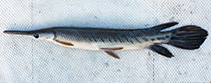
Entorno: milieu / zona climática / rango de profundidad / gama de distribución
Ecología
; agua dulce demersal. Tropical
Central America: Caribbean and Pacific drainages of southern Mexico and Central America.
Longitud en la primera madurez / Tamaño / Peso / Edad
Madurez: Lm 45.5, range 50 - 60 cm
Max length : 125 cm TL macho / no sexado; (Ref. 36722); peso máximo publicado: 2.9 kg (Ref. 40637)
Facultative air-breathing (Ref. 126274); Inhabit backwaters and slow moving sections of rivers and lakes. Often found in the warm stagnant waters of the lowland. Visible on the surface and resemble floating logs. Enter shallow lakes at the beginning of the dry season to spawn and known to reproduce also in June and July when rains are heaviest and rivers flood their banks providing an ideal spawning habitat of flooded vegetation. Large schools form to cast thousands of eggs in a gelatinous mass in the shallow waters. The adults return again to the river leaving the fry amongst the flooded vegetation (Ref. 36880). The eggs are poisonous to eat (Ref. 4537).
Ciclo vital y comportamiento de apareamiento
Madurez | Reproducción | Puesta | Huevos | Fecundidad | Larva
Ferraris, C.J. Jr., 2003. Lepisosteidae (Gars). p. 29. In R.E. Reis, S.O. Kullander and C.J. Ferraris, Jr. (eds.) Checklist of the Freshwater Fishes of South and Central America. Porto Alegre: EDIPUCRS, Brasil. (Ref. 36722)
Situación en la Lista Roja de la UICN (Ref. 130435: Version 2025-2 (Global))
Amenaza para el ser humano
Poisonous to eat (Ref. 4537)
Usos humanos
Herramientas
Informes especiales
Descargar XML
Fuentes de Internet
Estimaciones basadas en modelos
Índice de diversidad filogenética (Referencia
82804): PD
50 = 0.6426 [Uniqueness, from 0.5 = low to 2.0 = high].
Bayesian length-weight: a=0.00229 (0.00093 - 0.00562), b=3.19 (2.97 - 3.41), in cm total length, based on LWR estimates for this (Sub)family-body shape (Ref.
93245).
Nivel trófico (Referencia
69278): 4.2 ±0.73 se; based on food items.
Resiliencia (Referencia
120179): Muy bajo, población duplicada en un tiempo mínimo superior a 14 años (Preliminary K or Fecundity.).
Vulnerabilidad pesquera (Ref.
59153): High to very high vulnerability (75 of 100).
🛈