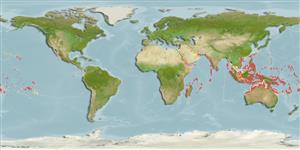
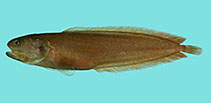
Môi trường: môi trường / vùng khí hậu / Mức độ sâu / phạm vi phân phối
Sinh thái học
biển cùng sống ở rạn san hô; mức độ sâu 1 - 30 m (Ref. 1602). Tropical; 30°N - 28°S
Eastern Indian Ocean: although reported to occur widely in the Indo-Pacific, specimens have only been collected at the Batu Islands, off Sumatra, Indonesia. Western Indian Ocean: Gravid females have been collected from Seychelles Islands (Ref. 45699).
Chiều dài lúc trưởng thành đầu tiên / Bộ gần gũi / Khối lượng (Trọng lượng) / Tuổi
Chín muồi sinh dục: Lm 4.8, range 5 - 5 cm
Max length : 12.0 cm SL con đực/không giới tính; (Ref. 1602)
Các tia vây lưng cứng (tổng cộng) : 0; Các vây lưng mềm (tổng cộng) : 75 - 88; Tia cứng vây hậu môn: 0; Tia mềm vây hậu môn: 59 - 69; Động vật có xương sống: 41 - 45.
Body shape (shape guide): elongated; Cross section: compressed.
Rare species (Ref. 34024) notable for its strict association with true reef environments and particularly so with outer reefs and reef cores (Ref. 81230). An indweller of deep interstices of lagoon and seaward reefs to a depth of at least 30 m (Ref. 1602). Ovoviviparous (Ref. 240). Solitary inhabitant of shallow water, cryptic (Ref 90102).
Ovoviviparous. Sexes can be readily distinguished by the male's intromittent organ and the female's genital pore (Ref. 240, 205). On the basis of this morphology, copulation may involve flexion of the male's body and pumping of sperm into the female (Ref. 240). Embryos are retained in the ovaries until about 6 mm long, deriving nourishment from large yolk sacs, making the species ovoviviparous rather than viviparous (Ref. 240).
Nielsen, J.G., D.M. Cohen, D.F. Markle and C.R. Robins, 1999. Ophidiiform fishes of the world (Order Ophidiiformes). An annotated and illustrated catalogue of pearlfishes, cusk-eels, brotulas and other ophidiiform fishes known to date. FAO Fish. Synop. 125(18):178p. Rome: FAO. (Ref. 34024)
Tình trạng Sách đỏ IUCN (Ref. 130435: Version 2025-2 (Global))
Mối đe dọa đối với con người
Harmless
Sử dụng của con người
Các nghề cá: có khả năng có lợi
Các công cụ
Báo cáo đặc biệt
Tải xuống XML
Các nguồn internet
Ước tính dựa trên mô hình
Nhiệt độ ưa thích (Tài liệu tham khảo
123201): 25.5 - 29.3, mean 28.4 °C (based on 3018 cells).
Chỉ số đa dạng phát sinh loài (Tài liệu tham khảo
82804): PD
50 = 0.7500 [Uniqueness, from 0.5 = low to 2.0 = high].
Bayesian length-weight: a=0.00389 (0.00180 - 0.00842), b=3.12 (2.94 - 3.30), in cm total length, based on all LWR estimates for this body shape (Ref.
93245).
Mức dinh dưỡng (Tài liệu tham khảo
69278): 2.6 ±0.1 se; based on diet studies.
Sự dễ bị tổn thương của nghề đánh cá (Ref.
59153): Low vulnerability (10 of 100).
🛈
Chất dinh dưỡng (Ref.
124155): Calcium = 138 [75, 245] mg/100g; Iron = 0.922 [0.534, 1.561] mg/100g; Protein = 16.9 [14.3, 19.3] %; Omega3 = 0.11 [0.06, 0.19] g/100g; Selenium = 32.5 [16.6, 73.1] μg/100g; VitaminA = 88.1 [26.6, 286.7] μg/100g; Zinc = 2.24 [1.53, 3.13] mg/100g (wet weight);