Miljö: miljö / Klimatzon / djupintervall / distributionsområde
Ekologi
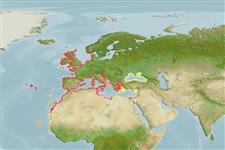
marina; sötvatten; brackvatten bottenlevande; amfidrom (Ref. 46888); djupintervall 0 - 15 m (Ref. 45332). Subtropical; 8°C - 24°C (Ref. 4944); 60°N - 12°N, 32°W - 42°E
Eastern Atlantic: western Scotland to Senegal. Also known from the Mediterranean and Black Sea. Lessepsian migrant to the Red Sea (Ref. 5299). Records from Pointe Noire and vicinity might be doubtful.
Längd vid första mognad / Storlek / Vikt / Ålder
Könsmognad: Lm 6.5, range 6 - 7 cm
Max length : 13.0 cm TL hane/ej könsbestämd; (Ref. 49698); rapporterad maxålder: 10 år (Ref. 35388)
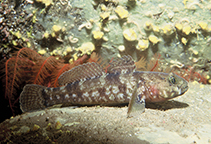
Neck naked. No black spots in the front end of each dorsal fin (Ref. 35388).
Body shape (shape guide): fusiform / normal.
Predominantly marine, but may enter freshwater. Adults occur inshore in intertidal waters, under stones and in pools on sheltered rocky shores with much weed cover. Macrobenthos feeder on hard substrates (Ref. 92840), they feed on crustaceans (larger amphipods, isopods, small crabs) and polychaetes; juveniles eat harpacticoid copepods, amphipods, polychaetes and mites (Ref. 4696). Oviparous (Ref. 205). Fusiform shaped eggs are found in patches of several thousand on undersurface of stones, shells, polychaete tubes or Ciona mantles (Ref. 4696).
Oviparous (Ref. 205). Male guards the eggs deposited by the female under rocks or inside empty bivalve shells until they hatch (Ref. 45332). Larvae remain near the substrate until they assume the cryptobenthic behavior of the adults (Ref. 45332). Are repeat spawners (Ref. 4696).
Maugé, L.A., 1986. Gobiidae. p. 358-388. In J. Daget, J.-P. Gosse and D.F.E. Thys van den Audenaerde (eds.) Check-list of the freshwater fishes of Africa (CLOFFA). ISNB, Brussels; MRAC, Tervuren; and ORSTOM, Paris. Vol. 2. (Ref. 4343)
Status på IUCN:s rödlista (Ref. 130435: Version 2025-2 (Global))
Hot mot människor
Harmless
Mänskliga användningsområden
Fiskeri: mindre kommeriell; Akvarium: Offentliga akvarier
Verktyg
Särskilda rapporter
Ladda ner XML
Internet-källor
Uppskattningar baserade på modeller
Önskad temperatur (Ref.
123201): 9.8 - 20.2, mean 17.7 °C (based on 823 cells).
Index för fylogenetisk mångfald (Ref.
82804): PD
50 = 0.5000 [Uniqueness, from 0.5 = low to 2.0 = high].
Bayesian length-weight: a=0.00871 (0.00676 - 0.01123), b=3.10 (3.07 - 3.13), in cm total length, based on LWR estimates for this species (Ref.
93245).
Trofisk nivå (Ref.
69278): 3.3 ±0.45 se; based on food items.
Generation time: 2.7 ( na - na) years. Estimated as median ln(3)/K based on 2
growth studies.
Resiliens (Ref.
120179): Mellan, lägsta populationsfördubblingstid 1,4-4,4 år (K=0.41; tm=0-3; tmax=10; Fec=1,054).
Sårbarhet i fisket (Ref.
59153): Low vulnerability (19 of 100).
🛈
Näringsämnen (Ref.
124155): Calcium = 215 [96, 483] mg/100g; Iron = 1.44 [0.78, 2.74] mg/100g; Protein = 18.8 [16.9, 20.4] %; Omega3 = 0.363 [0.160, 0.702] g/100g; Selenium = 14 [7, 29] μg/100g; VitaminA = 17.7 [5.5, 52.3] μg/100g; Zinc = 1.39 [0.94, 2.08] mg/100g (wet weight);