Umwelt: Milieu / Klimazone / Tiefenbereich / Verbreitungsgebiet
Ökologie
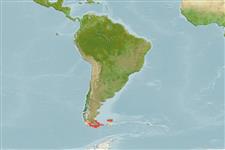
seewasser demersal; tiefenbereich 40 - 50 m. Temperate; 52°S - 57°S
South Atlantic and South Pacific: Straits of Magellan, south of Chile and Argentina, Patagonian Region and Staten Island. Falkland Islands and subantarctic islands (Ref. 4537).
Größe / Gewicht / Alter
Geschlechtsreife: Lm ? range ? - ? cm
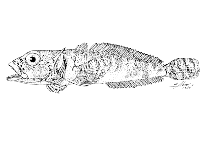
Max length : 9.5 cm SL Männchen/unbestimmt; (Ref. 117667)
Mainly in shallow, inshore waters, but may be found from 40-50 m. Occurs in tide pools, under rocks and among kelp (Ref. 5191). Feed on small crustaceans and common in littoral of all sub-Antarctic islands (Ref. 42041).
Lebenszyklus und Paarungsverhalten
Geschlechtsreife | Fortpflanzung | Ablaichen | Eier | Fruchtbarkeit | Larven
Females guard the eggs deposited in a nest they constructed for the four month incubation period (Ref. 89358).
Hureau, J.-C., 1990. Harpagiferidae. p. 357-363. In O. Gon and P.C. Heemstra (eds.) Fishes of the Southern Ocean. J.L.B. Smith Institute of Ichthyology, Grahamstown, South Africa. 462 p. (Ref. 5191)
IUCN Rote Liste Status (Ref. 130435: Version 2025-2 (Global))
Bedrohung für Menschen
Harmless
Nutzung durch Menschen
Fischereien: nicht kommerziell
Tools
Zusatzinformationen
Download XML
Internet Quellen
Schätzungen auf der Grundlage von Modellen
Bevorzugte Temperatur (Ref.
123201): 6.2 - 8, mean 7.1 °C (based on 8 cells).
Phylogenetischer Diversitätsindex (Ref.
82804): PD
50 = 0.5005 [Uniqueness, from 0.5 = low to 2.0 = high].
Bayesian length-weight: a=0.00525 (0.00204 - 0.01348), b=3.10 (2.88 - 3.32), in cm total length, based on LWR estimates for this (Sub)family-body shape (Ref.
93245).
Trophische Ebene (Ref.
69278): 3.3 ±0.4 se; based on diet studies.
Widerstandsfähigkeit (Ref.
120179): mittel, Verdopplung der Population dauert 1,4 - 4,4 Jahre. (Assuming Fec < 10,000).
Anfälligkeit der Fischerei (Ref.
59153): Low to moderate vulnerability (35 of 100).
🛈