Elasmobranchii (haaien en roggen) (sharks and rays) >
Squatiniformes (Angel sharks) >
Squatinidae (Angel sharks)
Etymology: Squatina: Latin for skate, which angel sharks superficially resemble, presumably tautonymous with Squalus squatina Linnaeus 1758 (no species mentioned) (See ETYFish); argentina: Presumably named for Argentina, described from off the coast of Buenos Aires (the province, not the city) (See ETYFish).
Milieu: milieu / Klimaatzone / Diepte / verspreidingsgebied
Ecologie
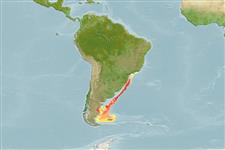
marien demersaal; diepte 100 - 400 m (Ref. 57911). Subtropical; 19°S - 53°S, 68°W - 38°W (Ref. 54901)
Southwest Atlantic: Brazil to southern Uruguay.
Grootte / Gewicht / Leeftijd
Maturiteit: Lm ? range ? - 120 cm
Max length : 170 cm TL mannelijk / geslacht onbekend; (Ref. 247); common length : 100.0 cm TL mannelijk / geslacht onbekend; (Ref. 6077)
Korte beschrijving
Determinatiesleutels | Morfologie | Morfometrie
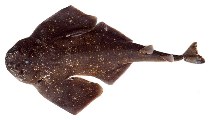
This species is distinguished from its congeners by having a darker background color, ranging from dark-brown to reddish-brown (vs. light-brown to dark-brown in S. guggenheim and S. occulta), with higher number of tooth rows with 24 vertical tooth rows in both upper and lower jaws, tooth formula 12-12/12-12; (vs. 9-9 to 10-10/9-9 to 11-11 in S. occulta, and 9-9 to 11-11/9-9 to 11-11 in S. guggenheim), and with anterior half of pectoral fin margin convex (vs. anterior margin of pectoral fin straight); differs from S. guggenheim and S. occulta with the interspiracular surface covered by small and homogeneous dorsal denticles, without enlarged denticles (vs. a pair of enlarged, conical and morphologically distinct dermal denticles between spiracles in S. occulta and S. guggenheim); differs from S. occulta by lacking blackish irregular small spots surrounding white spots on dorsal surface (i.e. absence of ocelli-like markings); differs further from S. guggenheim by having the dorsal midline denticles on trunk morphologically similar to other trunk denticles and barely organized in a row (vs. dorsal midline row of enlarged denticles morphologically distinct from other trunk denticles), the denticles close to origin of pectoral fin morphologically homogeneous, similar to other pectoral denticles (vs. presence of a pair, or more, enlarged and morphologically distinct denticles from other pectoral denticles, in S. guggenheim) (Ref. 95520).
Cross section: angular.
Found on the continental shelf and slope. Ovoviviparous (Ref. 50449).
Levenscyclus en paargedrag
Maturiteit | Voortplanting | Paaien | Eieren | Fecunditeit | Larven
Ovoviviparous, embryos feed solely on yolk (Ref. 50449). Both ovaries are functional (Ref. 57911).
Vaz, D.F.B. and M.R. De Carvalho, 2013. Morphological and taxonomic revision of species of Squatina from the Southwestern Atlantic Ocean (Chondrichthyes: Squatiniformes: Squatinidae). Zootaxa 3695(1):001-081. (Ref. 95520)
Status op de Rode Lijst van het IUCN (Ref. 130435: Version 2025-2 (Global))
Gevaar voor de mens
Traumatogenic
Gebruik door de mens
Visserij: visserij voor eigen gebruik
Tools
Speciale rapporten
Download XML
Internetbronnen
Schattingen op basis van modellen
Gewenste temperatuur (Ref.
123201): 4 - 16.3, mean 6.1 °C (based on 18 cells).
Fylogenetische diversiteitsindex (Ref.
82804): PD
50 = 0.5000 [Uniqueness, from 0.5 = low to 2.0 = high].
Bayesian length-weight: a=0.00661 (0.00287 - 0.01523), b=3.07 (2.88 - 3.26), in cm total length, based on LWR estimates for this Genus-body shape (Ref.
93245).
Trofisch niveau (Ref.
69278): 4.1 ±0.6 se; based on diet studies.
Weerstandsvermogen (Ref.
120179): Zeer laag, minimale populatieverdubbelingstijd meer dan 14 jaar (Fec 7-11).
Kwetsbaarheid van de visserij (Ref.
59153): Very high vulnerability (90 of 100).
🛈
Kwetsbaarheid voor het klimaat (Ref.
125649): High to very high vulnerability (71 of 100).
🛈
Voedingsstoffen (Ref.
124155): Calcium = 8.08 [1.10, 152.92] mg/100g; Iron = 0.689 [0.065, 8.563] mg/100g; Protein = 18.4 [16.3, 20.6] %; Omega3 = 0.288 [0.108, 0.796] g/100g; Selenium = 34.1 [6.7, 171.6] μg/100g; VitaminA = 5.73 [0.45, 68.92] μg/100g; Zinc = 0.355 [0.021, 4.093] mg/100g (wet weight);