>
Gobiiformes (Gobies) >
Gobiidae (Gobies) > Gobiinae
Etymology: Eviota: No etymology given, suggested by Christopher Scharpt: from Latin 'eu' for 'true' and 'iota' for anything very small, in combination 'truly very small' referring to it as being the smallest vertebrate at the time it has benn described by Jenkins (thus, making the suggestion by Scharpt plausible; cometa: Name from Latin word for comet, referring to the basicaudal spot and the trailing dark streak (Ref. 5291).
More on authors: Jewett & Lachner.
Ambiente: milieu / zona climática / intervalo de profundidade / gama de distribuição
Ecologia
marinhas associadas(os) a recifes; intervalo de profundidade 1 - 30 m (Ref. 127576). Tropical; 7°N - 24°S
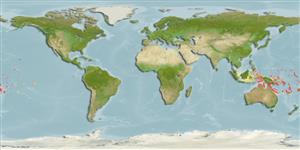
Southwestern Pacific: Fiji and Tonga.
Tamanho / Peso / Idade
Maturidade: Lm ? range ? - ? cm
Max length : 1.6 cm SL macho/indeterminado; (Ref. 127576)
Descrição breve
Chaves de identificação | Morfologia | Morfometria
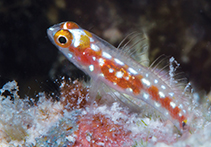
Espinhos dorsais (total) : 7; Raios dorsais moles (total) : 9; Espinhos anais: 1; Raios anais moles: 8. This species is distinguished from its congeners by the following characters: a cephalic sensory-canal pore pattern lacking only IT pore (pattern 2), AITO pore small and opening dorsally; a dorsal/anal fin-ray formula of 9/8; unbranched pectoral-fin rays 16 or 17 (usually 17); fifth pelvic-fin ray 5-17% of fourth ray; body depth 18-23% SL. Colouration: pectoral-fin base without dark occipital spots or dark spots; entire iris of eye is dark reddish, pupil surrounded by a white ring, dorsal side of eye next to interorbital area has a short white bar not visible laterally; a two-part, black, basicaudal spot over preural centrum made up of a short, wedge-like, triangular front section connecting to a short, wide bar over end of hypural plate, and with a yellow spot over nexus; caudal fin is crossed by thin, red, diagonal bars, pale when preserved (Ref. 127576).
Cross section: oval.
Collected from consolidated coral growth rising 2 m off sand and silt bottom, in 9-15 m depth; also from turbid waters on fine-sand and coral-rubble bottom (Ref. 127576).
Ciclo de vida e comportamento de acasalamento
Maturidade | Reprodução | Desova | Ovos | Fecundidade | Larvas
Tornabene, L., D.W. Greenfield and M.V. Erdmann, 2021. A review of the Eviota zebrina complex, with descriptions of four new species (Teleostei, Gobiidae). ZooKeys 1057:149-184. (Ref. 126577)
Categoria na Lista Vermelha da IUCN (Ref. 130435: Version 2025-2 (Global))
Ameaça para o homem
Harmless
Utilização humana
Ferramentas
Relatórios especiais
Descarregue XML
Fontes da internet
Estimativas baseadas em modelos
Índice de diversidade filogenética (Ref.
82804): PD
50 = 0.5000 [Uniqueness, from 0.5 = low to 2.0 = high].
Bayesian length-weight: a=0.01023 (0.00477 - 0.02194), b=3.01 (2.83 - 3.19), in cm total length, based on LWR estimates for this (Sub)family-body shape (Ref.
93245).
Nível Trófico (Ref.
69278): 3.0 ±0.3 se; based on size and trophs of closest relatives
Resiliência (Ref.
120179): Elevada, tempo mínimo de duplicação da população menor que 15 meses (Preliminary K or Fecundity.).
Vulnerabilidade da pesca (Ref.
59153): Low vulnerability (10 of 100).
🛈
Nutrientes (Ref.
124155): Calcium = 363 [161, 1,088] mg/100g; Iron = 1.64 [0.74, 3.48] mg/100g; Protein = 18.1 [16.0, 19.9] %; Omega3 = 0.166 [0.057, 0.455] g/100g; Selenium = 27.9 [9.5, 71.8] μg/100g; VitaminA = 127 [29, 575] μg/100g; Zinc = 4.22 [2.38, 6.86] mg/100g (wet weight);