>
Gobiiformes (Gobies) >
Gobiidae (Gobies) > Gobiinae
Etymology: Mahidolia: Named for His Royal Highness Prince Mahidol of Songkla, for his interest in the fishes and fisheries of Siam (Smith, 1932 original publication).
Eponymy: Mahidol Adulyadej (1892–1929), Prince of Songkla, was honoured for his interest in the fishes and fisheries of Siam (Thailand). (Ref. 128868), visit book page.
More on author: Valenciennes.
Entorno: milieu / zona climática / rango de profundidad / gama de distribución
Ecología
marino; salobre asociado a arrecife; rango de profundidad 5 - 20 m (Ref. 86942), usually 5 - 20 m (Ref. 37816). Tropical; 32°N - 20°S
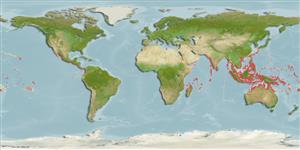
Indo-Pacific: East Africa south to Delagoa Bay, Mozambique (Ref. 2798) and east to the Society Islands, north to southern Japan (?), south to northern Australia and Samoa.
Tamaño / Peso / Edad
Madurez: Lm ? range ? - ? cm
Max length : 8.0 cm TL macho / no sexado; (Ref. 9710)
Descripción breve
Claves de identificación | Morfología | Morfometría
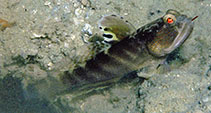
Espinas dorsales (total) : 7; Radios blandos dorsales (total) : 10; Espinas anales: 1; Radios blandos anales: 9. Characterized by generally pale grey to yellowish body color; about six slightly diagonal bands on body; head with orange spots; usually with one or more black spots on first dorsal fin; variable coloration of fins; first dorsal fin, fan like; united pelvic fins, frenum present; longitudinal scale series 33-37; head without scales; greatest depth of body 3.9-4.4 in SL; rounded caudal fin, about equal to head length (Ref. 90102).
Body shape (shape guide): elongated; Cross section: circular.
Occurs in silty coastal bays (Ref. 9710). Enters estuaries (Ref. 4343) and freshwater tidal zone habitats (Ref. 12693). Found on muddy bottom at the base of the reef at Toguan Bay, Guam. Uses the burrow of a mottled brown alpheid prawn with two or more short white saddles or spots. Lives coastal sand and mud habitats from shallow estuaries to moderate depths on slopes (Ref. 48637).
Ciclo vital y comportamiento de apareamiento
Madurez | Reproducción | Puesta | Huevos | Fecundidad | Larva
Myers, R.F., 1991. Micronesian reef fishes. Second Ed. Coral Graphics, Barrigada, Guam. 298 p. (Ref. 1602)
Situación en la Lista Roja de la UICN (Ref. 130435: Version 2025-2 (Global))
Amenaza para el ser humano
Harmless
Usos humanos
Pesquerías: comercial; Acuario: Comercial
Herramientas
Informes especiales
Descargar XML
Fuentes de Internet
Estimaciones basadas en modelos
Temperatura preferida (Referencia
123201): 25.9 - 29.1, mean 28.3 °C (based on 818 cells).
Índice de diversidad filogenética (Referencia
82804): PD
50 = 0.7500 [Uniqueness, from 0.5 = low to 2.0 = high].
Bayesian length-weight: a=0.00741 (0.00347 - 0.01582), b=3.09 (2.91 - 3.27), in cm total length, based on LWR estimates for this (Sub)family-body shape (Ref.
93245).
Nivel trófico (Referencia
69278): 4.0 ±0.65 se; based on food items.
Resiliencia (Referencia
120179): Alto, población duplicada en un tiempo mínimo inferior a 15 meses (Preliminary K or Fecundity.).
Vulnerabilidad pesquera (Ref.
59153): Low vulnerability (10 of 100).
🛈
Nutrientes (Ref.
124155): Calcium = 147 [71, 314] mg/100g; Iron = 0.777 [0.381, 1.547] mg/100g; Protein = 18.5 [16.5, 20.2] %; Omega3 = 0.111 [0.045, 0.229] g/100g; Selenium = 21.1 [8.3, 56.7] μg/100g; VitaminA = 145 [38, 510] μg/100g; Zinc = 2.21 [1.35, 3.34] mg/100g (wet weight);