การจำแนกประเภท / ชื่อ
ชื่อสามัญ | ชื่อพ้อง | Catalog of Fishes(สกุล, ชนิด) | ITIS | CoL | WoRMS | Cloffa
sub class Elasmobranchii (ฉลามและกระเบน) (sharks and rays) >
Pristiophoriformes (Saw sharks) >
Pristiophoridae (Saw sharks)
Etymology: Pristiophorus: pristio-, presumably derived from prio (Gr.), to saw, but treated here as a noun (a saw); phorus, from phoreus (Gr.), bearer or carrier, referring to saw-like snout (note also that pristis is Greek for sawfish) (See ETYFish); japonicus: -icus (L.), belonging to: Japan, where type locality (not specified) is situated (See ETYFish).
More on author: Günther.
สิ่งแวดล้อม : สิ่งแวดล้อม / เขตภูมิอากาศ / ระดับความลึก / ระยะการกระจายสินค้า
นิเวศวิทยา
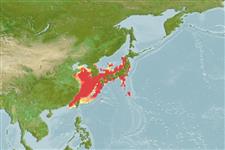
เกี่ยวกับทะเล,น้ำเค็ม สัตว์น้ำหน้าดิน; ระดับความลึก 0 - 500 m (Ref. 54710). Deep-water; 48°N - 22°N, 118°E - 145°E (Ref. 54710)
Northwest Pacific: Japan, Korea, northern China. Does not occur in the Western Central Pacific (Ref. 31368).
ขนาด / น้ำหนัก / อายุ
วัยเจริญพันธุ์: Lm ? range ? - ? cm
Max length : 136.0 cm TL (female)
คำอธิบายสั้นๆ
เครื่องมือที่ใช้ในการแยกชนิดสัตว์,สิ่งมีชีวิตออกจากกัน | สัณฐานวิทยา | ความยาวต่างๆ
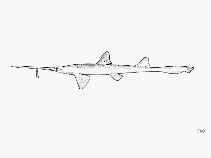
Pristiophorus japonicus has a long, narrow, and narrowly tapering rostrum (rostrum length is 26-29% of TL), distance from rostral tip to barbels about equal or slightly greater than distance from barbels to mouth (1:1.1-1.2); distance from rostral barbels to nostrils about equal to distance from nostrils to 1st gill slits. About 15-26 large rostral teeth on each side of the rostrum in front of the barbels, 9-17+ behind them; distance from mouth to nostrils 1.1-1.2 times internarial space. Tooth rows 34-58 in upper jaw. Dorsal and pectoral fins covered with denticles in large specimens. Lateral trunk denticles largely unicuspidate. First dorsal fin origin behind free rear tips of pectorals by eye length or more (Ref. 247).
Caudal fin almost straight, with slender upper and lower lobes; pectoral well developed but are not ray-like (Ref. 6871).
Body shape (shape guide): elongated.
Lives on continental shelves and upper slopes on or near the bottom. Also found in coastal waters on sand or mud bottoms. Feeds on small bottom organisms using its barbels to poke the bottom with its snout. Ovoviviparous, with 12 young in a litter.
วงจรชีวิตและพฤติกรรมการผสมพันธุ์
วัยเจริญพันธุ์ | การสืบพันธุ์ | การวางไข่ | เซลสืบพันธ์ของเพศเมีย(ไข่) | ความดกของไข่ | ตัวอ่อน
Ovoviviparous, embryos feed solely on yolk (Ref. 50449).
Compagno, L.J.V., 1984. FAO Species Catalogue. Vol. 4. Sharks of the world. An annotated and illustrated catalogue of shark species known to date. Part 1 - Hexanchiformes to Lamniformes. FAO Fish. Synop. 125(4/1):1-249. Rome, FAO. (Ref. 247)
สถานะบัญชีแดงของ IUCN (Ref. 130435: Version 2025-2 (Global))
ภัยคุกคามต่อมนุษย์
Harmless
การใช้ของมนุษย์
การประมง: การค้า
เครื่องมือ
รายงานพิเศษ
ดาวน์โหลด XML
แหล่งที่มาจากอินเตอร์เน็ต
การประมาณค่าตามแบบจำลอง
อุณหภูมิที่ต้องการ (อ้างอิง
123201): 7.7 - 21.8, mean 17.4 °C (based on 199 cells).
ดัชนีความหลากหลายทางวิวัฒนาการ (อ้างอิง
82804): PD
50 = 0.5098 [Uniqueness, from 0.5 = low to 2.0 = high].
Bayesian length-weight: a=0.00389 (0.00180 - 0.00842), b=3.12 (2.94 - 3.30), in cm total length, based on all LWR estimates for this body shape (Ref.
93245).
ระดับชั้นอาหาร (อ้างอิง
69278): 3.8 ±0.58 se; based on food items.
ความสามารถในการกลับคืนสู่ปกติ (อ้างอิง
120179): ต่ำ, เวลาต่ำสุดที่จะทำให้ประชากรเพิ่มขึ้นเป็น 2 เท่าใช้เวลา 4.5 - 14 ปี (Fec=12).
ความเสี่ยงต่อการตกปลา (Ref.
59153): Very high vulnerability (82 of 100).
🛈