>
Gobiiformes (Gobies) >
Gobiidae (Gobies) > Gobiinae
Etymology: Fusigobius: Latin, fusus = spindle + Latin, gobius = gudgeon (Ref. 45335).
More on author: Günther.
Umwelt: Milieu / Klimazone / Tiefenbereich / Verbreitungsgebiet
Ökologie
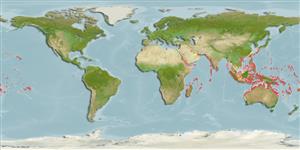
seewasser riff-verbunden; tiefenbereich 0 - 25 m (Ref. 11441). Tropical; 21°C - 30°C (Ref. 27115); 35°N - 33°S, 32°E - 143°W
Indo-Pacific: East Africa to the Tuamoto Islands, north to Ryukyu Islands, south to Lord Howe Island.
Größe / Gewicht / Alter
Geschlechtsreife: Lm ? range ? - ? cm
Max length : 7.5 cm TL Männchen/unbestimmt; (Ref. 2334)
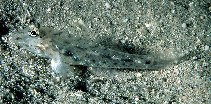
Rückenflossenstacheln (insgesamt) : 7; Rückenflossenweichstrahlen (insgesamt) : 9; Afterflossenstacheln: 1; Afterflossenweichstrahlen: 8. 1st black spot between 1st 2 dorsal spines; body with small dark spots (Ref. 2798); characterized by semi-translucent grey with small brown spots on head and body; presence of slanting bands along back; fully united pelvic fins; well developed pelvic frenum; rounded caudal fin; longitudinal scale series 22-24; ctenoid scales those on nape; cycloid scales on breast and base of pectoral fin; operculum without scales; median predorsal scales absent, 5-6 scales on side of nape anterior to dorsal fin origin; opening of gill extending nearly to below rear edge of opercle; depth of body 4.0-4.6 in SL (Ref. 90102).
Body shape (shape guide): fusiform / normal.
Solitary or in small groups (Ref. 90102). Inhabits tidal reef flats and shallow lagoons, on sand or rubble patches (Ref. 48637). Feeds on organic matter and small benthic invertebrates (Ref. 89972).
Lebenszyklus und Paarungsverhalten
Geschlechtsreife | Fortpflanzung | Ablaichen | Eier | Fruchtbarkeit | Larven
Benthic spawner.
Randall, J.E., 1995. Coastal fishes of Oman. University of Hawaii Press, Honolulu, Hawaii. 439 p. (Ref. 11441)
IUCN Rote Liste Status (Ref. 130435: Version 2025-2 (Global))
Bedrohung für Menschen
Harmless
Nutzung durch Menschen
Fischereien: kommerziell; Aquarium: Kommerziell
Tools
Zusatzinformationen
Download XML
Internet Quellen
Schätzungen auf der Grundlage von Modellen
Bevorzugte Temperatur (Ref.
123201): 24.7 - 29.3, mean 28.2 °C (based on 3017 cells).
Phylogenetischer Diversitätsindex (Ref.
82804): PD
50 = 0.5005 [Uniqueness, from 0.5 = low to 2.0 = high].
Bayesian length-weight: a=0.01023 (0.00477 - 0.02194), b=3.01 (2.83 - 3.19), in cm total length, based on LWR estimates for this (Sub)family-body shape (Ref.
93245).
Trophische Ebene (Ref.
69278): 2.9 ±0.25 se; based on food items.
Widerstandsfähigkeit (Ref.
120179): hoch, Verdopplung der Population dauert weniger als 15 Monate. (Preliminary K or Fecundity.).
Anfälligkeit der Fischerei (Ref.
59153): Low vulnerability (10 of 100).
🛈
Nährstoffe (Ref.
124155): Calcium = 155 [81, 326] mg/100g; Iron = 0.957 [0.493, 1.771] mg/100g; Protein = 18.3 [16.3, 20.0] %; Omega3 = 0.149 [0.068, 0.267] g/100g; Selenium = 22.6 [12.0, 45.5] μg/100g; VitaminA = 125 [35, 405] μg/100g; Zinc = 2.34 [1.55, 3.48] mg/100g (wet weight);