Ελασμοβράγχιοι (καρχαρίες και σαλάχια) (sharks and rays) >
Squaliformes (Sleeper and dogfish sharks) >
Oxynotidae (Rough sharks)
Etymology: Oxynotus: oxys (Gr.), sharp; notos (Gr.), back, referring to its keeled back (“dorso carenato”) (See ETYFish); centrina: From “Centrina,” name for this shark dating to at least Giovio’s De romanis piscibus (1524), presumably derived from centrum (L.), prickle or sharp point, referring to spines on both dorsal fins (See ETYFish).
More on author: Linnaeus.
Περιβάλλον: περιβάλλον / κλιματική ζώνη / εύρος βάθους / εύρος διανομής
Οικολογία
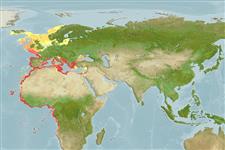
Θαλασσινό(ά) βαθύβιο(ς); εύρος βάθους 60 - 1309 m (Ref. 128029). Deep-water; 70°N - 17°S, 25°W - 36°E (Ref. 54693)
Eastern Atlantic: Bay of Biscay and Mediterranean Sea to Senegal, north to Cornwall, England (apparently as a stray). Compagno et al. (Ref. 5578) reports this species as ranging south to Cape Point, South Africa but Springer 1990 (Ref. 10718) notes Bass et al. 1976 as considering specimens from Walvis Bay distinct from Oxynotus centrina calling attention to the considerably greater distance between dorsal fins in Mediterranean specimens than in specimens taken south of the equator.
Μήκος κατά την πρώτη ωρίμανση / Μέγεθος / Βάρος / Ηλικία
Γεννητική Ωρίμανση: Lm ?, range 50 - ? cm
Max length : 150 cm TL αρσενικό/απροσδιόριστο; (Ref. 247); common length : 55.0 cm TL αρσενικό/απροσδιόριστο; (Ref. 26999)
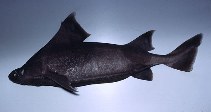
Ραχιαίες άκανθες (συνολικά) : 2; Εδρικές άκανθες: 0. A small bizarre-looking shark with an unmistakable high body and bristly textured skin (Ref. 5578). Uniformly grey to grey-brown (Ref. 5578).
Body shape (shape guide): elongated.
Found on the outer continental shelf and upper slope (Ref. 5578). Depth range from 60-660 m (Ref. 247) and from 549-777 m in the eastern Ionian Sea (Ref. 56504), and 818-1309 m NW Africa (Ref. 128029). Feeds on polychaetes (Ref. 247) and sipunculids (apparenly a suction feeder which mainly feeds on worm-like prey), which are rapidly digested, and the rapid gastric evacuation could partially explain the vacuity of several guts; teleosts, crustaceans and echinoderms are considered as accessory prey items, thus recorded predation on egg cases of the smallspotted catshark Scyliorhinus canicula remains an occasional phenomenon (Ref. 81816). Ovoviviparous (Ref. 205). Utilized for fishmeal, oil, and smoked and dried salted for human consumption (Ref. 247).
Ovoviviparous, without a placenta, with about 7 or 8 young in a litter (Ref. 247). Distinct pairing with embrace (Ref. 205).
Compagno, L.J.V., 1984. FAO Species Catalogue. Vol. 4. Sharks of the world. An annotated and illustrated catalogue of shark species known to date. Part 1 - Hexanchiformes to Lamniformes. FAO Fish. Synop. 125(4/1):1-249. Rome, FAO. (Ref. 247)
Κατάσταση Κόκκινου Καταλόγου IUCN (Ref. 130435: Version 2025-2 (Global))
Απειλή για τον άνθρωπο
Harmless
Ανθρώπινες χρήσεις
αλιεία: περιορισμένης εμπορικότητας
Εργαλεία
Ειδικές εκθέσεις
Λήψη XML
Διαδικτυακές πηγές
Εκτιμήσεις βάσει μοντέλων
Προτιμώμενη θερμοκρασία (Αναφ.
123201): 9.5 - 15.3, mean 13.3 °C (based on 283 cells).
Δείκτης φυλογενετικής ποικιλότητας (Αναφ.
82804): PD
50 = 0.5625 [Uniqueness, from 0.5 = low to 2.0 = high].
Bayesian length-weight: a=0.00363 (0.00158 - 0.00837), b=3.15 (2.94 - 3.36), in cm total length, based on LWR estimates for this (Sub)family-body shape (Ref.
93245).
Τροφικό Επίπεδο (Αναφ.
69278): 3.1 ±0.3 se; based on diet studies.
Ελαστικότητα (Αναφ.
120179): Πολύ χαμηλό, ελάχιστος χρόνος για διπλασιασμό πληθυσμού > 14 έτη (Fec=7).
Ευπάθεια στην αλιεία (Ref.
59153): Very high vulnerability (90 of 100).
🛈
Ευπάθεια στο κλίμα (Ref.
125649): Moderate vulnerability (38 of 100).
🛈
Θρεπτικά συστατικά (Ref.
124155): Calcium = 5.91 [1.03, 31.36] mg/100g; Iron = 0.271 [0.065, 0.929] mg/100g; Protein = 18.7 [16.8, 20.5] %; Omega3 = 0.229 [0.074, 0.746] g/100g; Selenium = 18.8 [5.3, 65.9] μg/100g; VitaminA = 5.9 [1.1, 30.1] μg/100g; Zinc = 0.392 [0.185, 0.747] mg/100g (wet weight);