Ambiente: milieu / zona climatica / distribuzione batimetrica / gamma di distribuzione
Ecologia
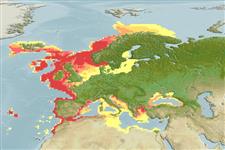
marino batidemersale; distribuzione batimetrica 20 - 1000 m (Ref. 6302). Deep-water; 75°N - 30°N, 28°W - 46°E (Ref. 54568)
Eastern Atlantic: south-western Barents Sea to Strait of Gibraltar including the Mediterranean and Black Sea. Reported from Iceland (Ref. 4712) and Mauritania (Ref. 5377). North Atlantic specimens attain larger sizes than those collected off West Africa and they also occur in shallower depths.
Lunghezza alla prima maturità / Dimensione / Peso / Età
Maturità: Lm 55.0, range 35 - 60 cm
Max length : 200 cm SL maschio/sesso non determinato; (Ref. 4712); common length : 100.0 cm SL maschio/sesso non determinato; (Ref. 4712); peso massimo pubblicato: 57.7 kg (Ref. 40637); Età massima riportata: 24 anni (Ref. 46508)
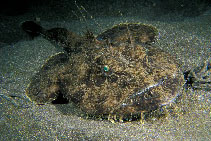
Spine dorsali (totale) : 8; Raggi dorsali molli (totale) : 11 - 12; Raggi anali molli: 9 - 10. Peritoneum pale. Head and body depressed. Mouth wide and cavernous. Skin thin and loose, scales absent. Esca bifid, 2 broad, flattened , leaf-like blades. Dorsal spines long, stout and bearing many well-developed tendrils; 4th spine greater than snout width (Ref. 4712).
Body shape (shape guide): short and / or deep; Cross section: flattened.
Occurs on sandy and muddy bottoms from the coast (below 20 m, Ref. 12382) down to depths of 1,000 m. May also be found on rocky bottoms (Ref. 12382). It lies half-buried in the sediment waiting for its prey. It attracts prey by means of its fishing filament (Ref. 5377). Feeds mainly on fishes, occasionally sea-birds. Marketed fresh and frozen; eaten steamed, sautéed, broiled, boiled, fried, microwaved and baked (Ref. 9988). It is a well-studied species in Europe and is sold without the skin and the head under the name 'queue de Lotte' (Ref. 5377). Does not adapt well in home aquariums due to its large size (Ref. 12382).
Caruso, J.H., 1986. Lophiidae. p. 1362-1363. In P.J.P. Whitehead, M.-L. Bauchot, J.-C. Hureau, J. Nielsen and E. Tortonese (eds.) Fishes of the North-eastern Atlantic and the Mediterranean, Volume 3. Unesco, Paris. (Ref. 4712)
Stato della Lista Rossa IUCN (Ref. 130435: Version 2025-2 (Global))
Minaccia per l'uomo
Harmless
Usi umani
Pesca: elevato interesse commerciale
Strumenti
Rapporti speciali
Scarica XML
Fonti Internet
Stime basate su modelli
Temperatura preferita (Fonte Biblio.
123201): 3.8 - 14.2, mean 7.7 °C (based on 468 cells).
Indice di diversità filogenetica (Fonte Biblio.
82804): PD
50 = 0.5078 [Uniqueness, from 0.5 = low to 2.0 = high].
Bayesian length-weight: a=0.01585 (0.01277 - 0.01966), b=2.92 (2.85 - 2.99), in cm total length, based on LWR estimates for this species (Ref.
93245).
Livello trofico (Fonte Biblio.
69278): 4.5 ±0.1 se; based on diet studies.
Generation time: 11.0 (8.5 - 14.1) years. Estimated as median ln(3)/K based on 13
growth studies.
Resilienza (Fonte Biblio.
120179): Medio, tempo minimo di raddoppiamento della popolazione 1.4 - 4.4 anni (K=0.07-0.33; tm=4.5-14; tmax=24; Fec=1 million).
Prior r = 0.47, 95% CL = 0.31 - 0.70, Based on 8 full stock assessments.
Vulnerabilità della pesca (Ref.
59153): High vulnerability (64 of 100).
🛈
Vulnerabilità climatica (Ref.
125649): Moderate vulnerability (44 of 100).
🛈
Nutrienti (Ref.
124155): Calcium = 10.8 [5.5, 23.4] mg/100g; Iron = 0.381 [0.157, 0.847] mg/100g; Protein = 19.9 [16.2, 22.3] %; Omega3 = 0.214 [0.097, 0.481] g/100g; Selenium = 19.7 [7.1, 58.6] μg/100g; VitaminA = 4.58 [0.76, 28.24] μg/100g; Zinc = 0.137 [0.073, 0.438] mg/100g (wet weight); based on
nutrient studies.