>
Zeiformes (Dories) >
Oreosomatidae (Oreos) > Pseudocyttinae
Etymology: Pseudocyttus: Greek, pseudes = false + Greek, kyttaros, kytos = a convex cavity.
Milieu: milieu / Klimaatzone / Diepte / verspreidingsgebied
Ecologie
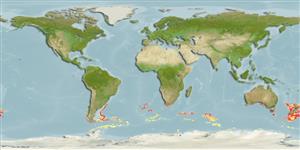
marien bathydemersaal; oceanodroom (Ref. 51243); diepte 400 - 1500 m (Ref. 5194), usually 900 - 1100 m (Ref. 36731). Deep-water; 34°S - 67°S, 90°W - 176°W (Ref. 27159)
Southwest Atlantic: off Uruguay to Argentina and the Falklands. Southeast Atlantic: Namibia to South Africa, including the northern part of Walvis Ridge (Ref. 6545). South Pacific: off southern Chile, Bellingshausen and Australian-Antarctic Basin to New Zealand, New South Wales and Tasmania, Australia and the Kerguelen Islands.
Lengte bij maturiteit / Grootte / Gewicht / Leeftijd
Maturiteit: Lm 40.0 range ? - 41 cm
Max length : 68.0 cm TL mannelijk / geslacht onbekend; (Ref. 58312); common length : 40.0 cm TL mannelijk / geslacht onbekend; (Ref. 9258); max. gepubliceerd gewicht: 5.0 kg (Ref. 6390); max. gerapporteerde leeftijd: 100 Jaren (Ref. 27140)
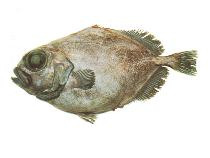
Dorsale stekels (totaal) : 5 - 7; Dorsale zachte stralen (totaal) : 33 - 36; Anale stekels: 2 - 3; Anale zachte stralen: 31 - 34; Wervels: 40 - 43. First dorsal spine longer than second dorsal spine. Opercles fully scaled (Ref. 27159).
Female adult chocolate brown in color with darker fins; prejuveniles silvery with numerous dark spots of various sizes which become larger with age (Ref. 6548).
Body shape (shape guide): short and / or deep.
Inhabit continental slopes of all southern continents (Ref. 6545). Adults found near the bottom; juveniles near the surface, usually in association with krill (Ref. 5194). Feed mainly on salps (Ref. 27150). Eggs float near the sea surface and larvae also inhabit surface waters (Ref. 6390). There is no vertical migration during the day or night (Ref. 27150).
Displays seasonally synchronised reproduction (Ref. 6390).
Heemstra, P.C., 1990. Oreosomatidae. p. 226-228. In O. Gon and P.C. Heemstra (eds.) Fishes of the Southern Ocean. J.L.B. Smith Institute of Ichthyology, Grahamstown, South Africa. (Ref. 5194)
Status op de Rode Lijst van het IUCN (Ref. 130435: Version 2025-2 (Global))
Gevaar voor de mens
Harmless
Gebruik door de mens
Visserij: commercieel
Tools
Speciale rapporten
Download XML
Internetbronnen
Schattingen op basis van modellen
Gewenste temperatuur (Ref.
123201): 2.1 - 6.1, mean 4.2 °C (based on 189 cells).
Fylogenetische diversiteitsindex (Ref.
82804): PD
50 = 1.0010 [Uniqueness, from 0.5 = low to 2.0 = high].
Bayesian length-weight: a=0.01995 (0.00809 - 0.04920), b=2.99 (2.77 - 3.21), in cm total length, based on LWR estimates for this (Sub)family-body shape (Ref.
93245).
Trofisch niveau (Ref.
69278): 3.6 ±0.47 se; based on food items.
Weerstandsvermogen (Ref.
120179): Zeer laag, minimale populatieverdubbelingstijd meer dan 14 jaar (K=0.02-0.1; tmax=100; tm=31; Fec=6,000).
Kwetsbaarheid van de visserij (Ref.
59153): High to very high vulnerability (72 of 100).
🛈
Kwetsbaarheid voor het klimaat (Ref.
125649): Moderate vulnerability (39 of 100).
🛈
Voedingsstoffen (Ref.
124155): Calcium = 16.2 [8.5, 36.6] mg/100g; Iron = 0.416 [0.153, 0.905] mg/100g; Protein = 17.2 [14.6, 20.0] %; Omega3 = 0.332 [0.167, 0.702] g/100g; Selenium = 24.3 [9.3, 71.5] μg/100g; VitaminA = 11.1 [1.8, 67.9] μg/100g; Zinc = 0.335 [0.207, 0.526] mg/100g (wet weight);