Lớp phụ Cá sụn (cá mập và cá đuối) (sharks and rays) >
Squaliformes (Sleeper and dogfish sharks) >
Oxynotidae (Rough sharks)
Etymology: Oxynotus: oxys (Gr.), sharp; notos (Gr.), back, referring to its keeled back (“dorso carenato”) (See ETYFish); bruniensis: -ensis, Latin suffix denoting place: the shore of Bruny Island, Tasmania, where holotype was discovered in a “dried … but fair state of preservation” (See ETYFish).
More on author: Ogilby.
Môi trường: môi trường / vùng khí hậu / Mức độ sâu / phạm vi phân phối
Sinh thái học
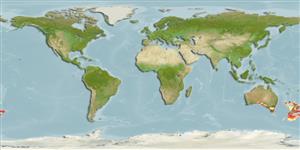
biển tầng đáy biển sâu; mức độ sâu 45 - 1070 m (Ref. 26346), usually 350 - 650 m (Ref. 6871). Deep-water; 31°S - 55°S, 125°E - 172°W (Ref. 54691)
Southwest Pacific: confined to temperate waters off southern Australia and New Zealand.
Chiều dài lúc trưởng thành đầu tiên / Bộ gần gũi / Khối lượng (Trọng lượng) / Tuổi
Chín muồi sinh dục: Lm ?, range 60 - ? cm
Max length : 65.0 cm TL con đực/không giới tính; (Ref. 122636); 74.0 cm TL (female); Khối lượng cực đại được công bố: 6.6 kg (Ref. 122636)
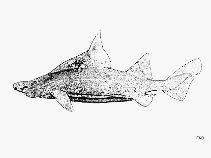
Tia cứng vây hậu môn: 0. Uniform grey-brown coloration; short, blunt snout; high sail-like dorsal fins with spines and broad apices, first dorsal spine inclined backward; high, thick triangular body with large, rough denticles; circular spiracles; lanceolate upper teeth, lower blade-like teeth in less than 12 rows (Ref. 247).
Body shape (shape guide): elongated.
Found on outer continental and insular shelves and uppermost slopes (Ref. 247). Probably feeds on bottom invertebrates and fishes. Ovoviviparous (Ref. 205). Taken incidentally with bottom trawls but probably not used (Ref. 247).
Ovoviviparous, with 7 young in a litter (Ref. 247). Size at birth about 24 cm (Ref. 6871). Distinct pairing with embrace (Ref. 205).
Compagno, L.J.V., 1984. FAO Species Catalogue. Vol. 4. Sharks of the world. An annotated and illustrated catalogue of shark species known to date. Part 1 - Hexanchiformes to Lamniformes. FAO Fish. Synop. 125(4/1):1-249. Rome, FAO. (Ref. 247)
Tình trạng Sách đỏ IUCN (Ref. 130435: Version 2025-2 (Global))
Mối đe dọa đối với con người
Harmless
Sử dụng của con người
Các nghề cá: không ích lợi (thú vị)
Các công cụ
Báo cáo đặc biệt
Tải xuống XML
Các nguồn internet
Ước tính dựa trên mô hình
Nhiệt độ ưa thích (Tài liệu tham khảo
123201): 6.2 - 10.4, mean 8 °C (based on 150 cells).
Chỉ số đa dạng phát sinh loài (Tài liệu tham khảo
82804): PD
50 = 0.5625 [Uniqueness, from 0.5 = low to 2.0 = high].
Bayesian length-weight: a=0.00363 (0.00158 - 0.00837), b=3.15 (2.94 - 3.36), in cm total length, based on LWR estimates for this (Sub)family-body shape (Ref.
93245).
Mức dinh dưỡng (Tài liệu tham khảo
69278): 4.0 ±0.62 se; based on food items.
Thích nghi nhanh (Tài liệu tham khảo
120179): Rất thấp, thời gian nhân đôi của chủng quần tối thiểu là hơn 14 năm (Fec=7).
Sự dễ bị tổn thương của nghề đánh cá (Ref.
59153): Moderate to high vulnerability (50 of 100).
🛈
Chất dinh dưỡng (Ref.
124155): Calcium = 8.32 [1.56, 44.88] mg/100g; Iron = 0.283 [0.065, 0.939] mg/100g; Protein = 18.8 [17.0, 20.6] %; Omega3 = 0.302 [0.100, 0.969] g/100g; Selenium = 14.1 [4.0, 44.8] μg/100g; VitaminA = 13.4 [2.6, 67.1] μg/100g; Zinc = 0.414 [0.198, 0.828] mg/100g (wet weight);