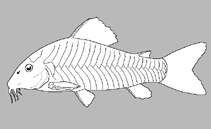
Clasificación / Nombres
Nombres comunes | Sinónimos | Catalog of Fishes(Género, Especie) | ITIS | CoL | WoRMS | Cloffa
>
Siluriformes (Catfishes) >
Callichthyidae (Callichthyid armored catfishes) > Corydoradinae
Etymology: hypnos: Name refers to Hypnos (Greek for ‘sleep’), the Greek god or personification of sleep, and the twin brother of Thanatos, the god/personification of death; referring to the fact that even though both C. hypnos and C. thanatos may have some similarities (in color pattern), they are completely different in other aspects (general morphological pattern); noun in apposition.
Entorno: milieu / zona climática / rango de profundidad / gama de distribución
Ecología
; agua dulce demersal. Tropical
South America: Brazil.
Tamaño / Peso / Edad
Madurez: Lm ? range ? - ? cm
Max length : 3.2 cm SL macho / no sexado; (Ref. 138443)
Descripción breve
Claves de identificación | Morfología | Morfometría
This species is distinguished by the following characters: with posterior margin of pectoral-fin spine with most serrations directed towards the tip of the spine; presence of contact between nuchal plate and posterior process of the parieto-supraoccipital; absence of a large-sized dark blotch on caudal-fin base; with dark brown or black markings at least in dorsal and caudal fins, none for the pectoral and pelvic fins; with moderately- to relatively well-developed and smoothly rounded snout; the ventral surface of trunk only with small-sized, non-coalescent platelets; midline of flank with longitudinal series of dark brown or black blotches, when present, diffuse, and mesethmoid partially exposed; anterior laminar expansion moderately developed, poorly expanded towards the anteroventral portion of snout, leaving most of its lateral surface exposed (Ref. 138443).
Body shape (shape guide): fusiform / normal; Cross section: oval.
Inhabits the main channel of the rio Jamanxim to its small tributary streams; mostly associated with the margins of the river, where juvenile specimens were observed shoaling together with juvenile and adult specimens of C. thanatos in the sandy shores, both species in relatively high abundance. In small streams, adult and juvenile specimens were found shoaling togeth; generally in sites with submerged branches, leaf litter, and sandy and/or fine gravel substrate, with C. thanatos in higher numbers than C. hypnos (Ref. 138443).
Ciclo vital y comportamiento de apareamiento
Madurez | Reproducción | Puesta | Huevos | Fecundidad | Larva
Tencatt, L.F.C., W.M. Ohara, L.M. de Sousa and M.R. Britto, 2022. Science and hobby joining forces for the discovery of three new Corydoras (Siluriformes: Callichthyidae) from the rio Tapajós basin, Brazil, with comments on Corydoras sp. CW111. Neotropical Ichthyology v. 20 (no. 3): e220070: 1-40. (Ref. 138443)
Situación en la Lista Roja de la UICN (Ref. 130435: Version 2025-2 (Global))
Amenaza para el ser humano
Harmless
Usos humanos
Herramientas
Informes especiales
Descargar XML
Fuentes de Internet
Estimaciones basadas en modelos
Índice de diversidad filogenética (Referencia
82804): PD
50 = 0.5000 [Uniqueness, from 0.5 = low to 2.0 = high].
Bayesian length-weight: a=0.01778 (0.00758 - 0.04173), b=3.02 (2.82 - 3.22), in cm total length, based on LWR estimates for this (Sub)family-body shape (Ref.
93245).
Nivel trófico (Referencia
69278): 3.0 ±0.4 se; based on size and trophs of closest relatives
Resiliencia (Referencia
120179): Alto, población duplicada en un tiempo mínimo inferior a 15 meses (Preliminary K or Fecundity.).
Vulnerabilidad pesquera (Ref.
59153): Low vulnerability (10 of 100).
🛈