>
Gadiformes (Cods) >
Macrouridae (Grenadiers or rattails)
Etymology: Macrourus: Greek, makroura = great tail (Ref. 45335).
Eponymy: Sir Thomas Barnby Whitson (1869–1948) was a Scottish accountant who was Treasurer and Accountant of the Scotia Committee; ‘Scotia’ was the ship from which the type was collected during the Scottish National Antarctic Expedition (1902–1904). [...] (Ref. 128868), visit book page.
More on author: Regan.
Umwelt: Milieu / Klimazone / Tiefenbereich / Verbreitungsgebiet
Ökologie
seewasser bathypelagisch; ozeanodrom (Ref. 51243); tiefenbereich 400 - 3185 m (Ref. 1371), usually 600 - 1500 m (Ref. 1371). Deep-water; 47°S - 79°S, 180°W - 180°E (Ref. 1371)
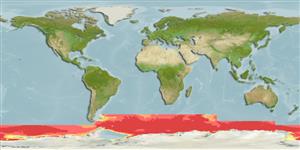
Southern Ocean: Circumpolar (generally confined inside the Convergence except in the Falkland Islands area).
Größe / Gewicht / Alter
Geschlechtsreife: Lm ? range ? - ? cm
Max length : 84.0 cm TL Männchen/unbestimmt; (Ref. 124151); max. veröff. Gewicht: 5.1 kg (Ref. 124151)
Rückenflossenstacheln (insgesamt) : 2; Rückenflossenweichstrahlen (insgesamt) : 124 - 125; Afterflossenstacheln: 0; Afterflossenweichstrahlen: 110. Eyes relatively large. Snout short, moderately pointed, usually somewhat rounded with a high dorsal profile in adults, but often with prominent tubercles at its tip and lateral angles. Mouth large, lips thin. Underside of the head generally covered with small scales. Pyloric caeca 18 to 28. Overall color dark brown to swarthy in most individuals, but some are much paler; fins and lips blackish (Ref. 1371).
Body shape (shape guide): elongated; Cross section: circular.
Remains of natant crustaceans (especially euphausiids), polychaetes, and fish (gonostomatids) have been found in the stomachs of three specimens examined.
Lebenszyklus und Paarungsverhalten
Geschlechtsreife | Fortpflanzung | Ablaichen | Eier | Fruchtbarkeit | Larven
Cohen, D.M., T. Inada, T. Iwamoto and N. Scialabba, 1990. FAO species catalogue. Vol. 10. Gadiform fishes of the world (Order Gadiformes). An annotated and illustrated catalogue of cods, hakes, grenadiers and other gadiform fishes known to date. FAO Fish. Synop. 125(10). Rome: FAO. 442 p. (Ref. 1371)
IUCN Rote Liste Status (Ref. 130435: Version 2025-2 (Global))
Bedrohung für Menschen
Harmless
Nutzung durch Menschen
Fischereien: kommerziell
Tools
Zusatzinformationen
Download XML
Internet Quellen
Schätzungen auf der Grundlage von Modellen
Bevorzugte Temperatur (Ref.
123201): -0.1 - 1.4, mean 0.6 °C (based on 598 cells).
Phylogenetischer Diversitätsindex (Ref.
82804): PD
50 = 0.5312 [Uniqueness, from 0.5 = low to 2.0 = high].
Bayesian length-weight: a=0.00204 (0.00124 - 0.00335), b=3.21 (3.06 - 3.36), in cm total length, based on LWR estimates for this species & (Sub)family-body (Ref.
93245).
Trophische Ebene (Ref.
69278): 3.5 ±0.49 se; based on food items.
Generation time: 20.0 ( na - na) years. Estimated as median ln(3)/K based on 2
growth studies.
Widerstandsfähigkeit (Ref.
120179): sehr niedrig, Verdopplung der Population dauert mehr als 14 Jahre. (Preliminary K or Fecundity.).
Anfälligkeit der Fischerei (Ref.
59153): High to very high vulnerability (68 of 100).
🛈
Klimaanfälligkeit (Ref.
125649): High vulnerability (65 of 100).
🛈
Nährstoffe (Ref.
124155): Calcium = 21.3 [6.7, 49.7] mg/100g; Iron = 0.311 [0.139, 0.894] mg/100g; Protein = 17.2 [14.9, 19.6] %; Omega3 = 0.113 [0.044, 0.283] g/100g; Selenium = 25.4 [8.2, 68.7] μg/100g; VitaminA = 27.1 [3.5, 217.6] μg/100g; Zinc = 0.472 [0.256, 0.945] mg/100g (wet weight);