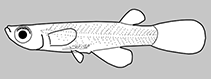
Clasificación / Nombres
Nombres comunes | Sinónimos | Catalog of Fishes(Género, Especie) | ITIS | CoL | WoRMS | Cloffa
>
Cyprinodontiformes (Rivulines, killifishes and live bearers) >
Fluviphylacidae (American lampeyes)
Etymology: Fluviphylax: Latin, fluvius = river + Greek,phylax, -akos = guardian (Ref. 45335); rubens: Name 'rubens' from the present participate of verb 'rubeo', meaning 'becoming red (invariable)', in reference to the male colour pattern of unpaired fins, and to the typical red colour preferably used by Flemish painter Peter Paul rubens (1577-1640).
Entorno: milieu / zona climática / rango de profundidad / gama de distribución
Ecología
; agua dulce bentopelágico. Tropical
South America: Colombia.
Tamaño / Peso / Edad
Madurez: Lm ? range ? - ? cm
Max length : 1.6 cm SL macho / no sexado; (Ref. 138060)
Descripción breve
Claves de identificación | Morfología | Morfometría
Radios blandos dorsales (total) : 4 - 5; Radios blandos anales: 7 - 8. This species is distinguished from its congeners by the following set of characters: dorsal fin 4 or 5; dissimilar colour pattern in male, made of rubens-red colour contrasted by black thin flames at all unpaired fins, except on tip of dorsal and caudal-fins and on base of anal-fin that remain hyaline; anal-fin rays usually 7 or 8; and anal-fin being short based, rounded and very deep, and by a very high D/A deviation ratio +9 to 11 (Ref. 138060).
Body shape (shape guide): elongated; Cross section: compressed.
Ciclo vital y comportamiento de apareamiento
Madurez | Reproducción | Puesta | Huevos | Fecundidad | Larva
Huber, J.H., 2025. Short description of Fluviphylax rubens n. sp., a new so-called lampeye Cyprinodontiformes from Colombia with exceptionally few dorsal-fin rays. Cybium 48(4):327-331. (Ref. 138060)
Situación en la Lista Roja de la UICN (Ref. 130435: Version 2025-2 (Global))
Amenaza para el ser humano
Harmless
Usos humanos
Pesquerías: sin interés
Herramientas
Informes especiales
Descargar XML
Fuentes de Internet
Estimaciones basadas en modelos
Índice de diversidad filogenética (Referencia
82804): PD
50 = 0.5078 [Uniqueness, from 0.5 = low to 2.0 = high].
Bayesian length-weight: a=0.00537 (0.00207 - 0.01392), b=3.09 (2.87 - 3.31), in cm total length, based on LWR estimates for this (Sub)family-body shape (Ref.
93245).
Nivel trófico (Referencia
69278): 3.0 ±0.4 se; based on size and trophs of closest relatives
Vulnerabilidad pesquera (Ref.
59153): Low vulnerability (10 of 100).
🛈