Klassifizierung / Names
Namen | Synonyme | Catalog of Fishes(Gattung, Arten) | ITIS | CoL | WoRMS | Cloffa
>
Cichliformes (Cichlids, convict blennies) >
Cichlidae (Cichlids) > Etroplinae
Etymology: Paretroplus: Name from the Greek 'para' meaning 'on the side of'; in taxonomy it is commonly used in generic names to express similarity or relatedness; in the present case it would mean 'next to Etroplus' (S.Kullander, pers.comm. 3/11); risengi: Named fro Karen J. Riseng, limnologist and who collected this new species.
Umwelt: Milieu / Klimazone / Tiefenbereich / Verbreitungsgebiet
Ökologie
; süßwasser demersal. Tropical
Africa: Madagascar.
Größe / Gewicht / Alter
Geschlechtsreife: Lm ? range ? - ? cm
Max length : 16.1 cm SL Männchen/unbestimmt; (Ref. 137964)
Kurzbeschreibung
Bestimmungsschlüssel | Morphologie | Morphometrie
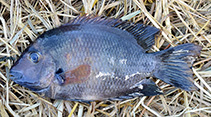
Rückenflossenstacheln (insgesamt) : 18 - 20; Rückenflossenweichstrahlen (insgesamt) : 11 - 14; Afterflossenstacheln: 9 - 11. This species is within the Paretroplus damii clade” based on the following apomorphic features shared with other members, including the presence of a dark gray to black pectoral-axil patch, highly embedded chest scales that are greatly reduced in size, and flank scales with a thin, unossified posterior field. It is differs from P. damii and P. loisellei, by the pigmentation pattern in preservation, with dark head, followed by broad, light colored anterolateral band, and dark posterior body (vs. mostly uniform dark gray to dark grayish-brown in non-breeding individuals of P. damii and P. loisellei), with even large adult specimens frequently appearing quite blotchy and mottled, and fewer gill rakers on the lower limb of the first arch (mode 11 vs. 12 [P. damiii] or 13 [P. loisellei]). Paretroplus risengi and P. damii further differs from P. loisellei by having a strongly rounded and convex profile extending from the anterior margin of the lower jaw to the ventroposterior margin of the suspensorium (vs. horizontal), obliquely oriented, thin lips (vs. horizontal with fleshy lips), a lighter non-breeding overall pigmentation pattern (vs. uniformly dark brown or grayish-brown flank), and striking yellow, vivid orange, or brick red breeding coloration on head and anterior flank, over a blackish base (vs. uniform bright golden). Paretroplus risengi and P. loisellei differs from P. damii by having a weakly tricuspid symphyseal teeth in the upper jaw (vs. lacking lateral cusps). Paretroplus risengi further differs from P. loisellei by a lower lateral line scale count (mode 37 vs. 38), fewer vertebrae (mode 31 vs. 32), and a lower epibranchial raker count (9-10 vs 11-12); differs from P. damii by a considerably more blotchy and mottled pigmentation pattern (in both preservation and non-breeding individuals), and by a smaller maximum adult size (max. size ~17.0 cm SL vs. regularly exceeding well over 30.0 cm SL) (Ref. 137964).
Body shape (shape guide): short and / or deep; Cross section: compressed.
Occurs in clear, rather swift flowing rivers over sandy to muddy substrate, generally among submerged tree branches and root systems. Throughout Lac Andrapongy, type locality, which is a large, shallow, turbid floodplain lake within the Anjingo-Ankofia drainage basin (Ref. 137964).
Lebenszyklus und Paarungsverhalten
Geschlechtsreife | Fortpflanzung | Ablaichen | Eier | Fruchtbarkeit | Larven
Sparks, J.S. and E.E. Sparks, 2025. A new species of Paretroplus (Teleostei: Cichlidae: Etroplinae) from northwestern Madagascar with a discussion of its relationships within the P. damii clade. Misc. Publ. Mus. Zool., Univ. Mich. 209(4):1-28. (Ref. 137964)
IUCN Rote Liste Status (Ref. 130435: Version 2025-2 (Global))
Bedrohung für Menschen
Harmless
Nutzung durch Menschen
Tools
Zusatzinformationen
Download XML
Internet Quellen
Schätzungen auf der Grundlage von Modellen
Phylogenetischer Diversitätsindex (Ref.
82804): PD
50 = 0.5001 [Uniqueness, from 0.5 = low to 2.0 = high].
Bayesian length-weight: a=0.01660 (0.00670 - 0.04111), b=2.95 (2.74 - 3.16), in cm total length, based on LWR estimates for this (Sub)family-body shape (Ref.
93245).
Trophische Ebene (Ref.
69278): 2.8 ±0.3 se; based on size and trophs of closest relatives
Widerstandsfähigkeit (Ref.
120179): hoch, Verdopplung der Population dauert weniger als 15 Monate. (Preliminary K or Fecundity.).
Anfälligkeit der Fischerei (Ref.
59153): Low vulnerability (10 of 100).
🛈