การจำแนกประเภท / ชื่อ
ชื่อสามัญ | ชื่อพ้อง | Catalog of Fishes(สกุล, ชนิด) | ITIS | CoL | WoRMS | Cloffa
>
Ovalentaria/misc (Various families in series Ovalentaria) >
Pomacentridae (Damselfishes) > Pomacentrinae
Etymology: Amphiprion: Greek, amphi = on both sides + Greek, prion, -onos = saw (Ref. 45335); maohiensis: Specific name after ma’ohiensis, which in Polynesian means belonging to the native land, ma’ohi.
สิ่งแวดล้อม : สิ่งแวดล้อม / เขตภูมิอากาศ / ระดับความลึก / ระยะการกระจายสินค้า
นิเวศวิทยา
เกี่ยวกับทะเล,น้ำเค็ม เกี่ยวกับหินโสโครก. Tropical
การแพร่กระจาย
อาณาเขต | พื้นที่จำแนกตาม FAO | ระบบนิเวศหลายระบบ | การปรากฏขึ้น,การเกิดขึ้น,พบ | ตำแหน่งบนแผนที่ | การแนะนำ | Faunafri
Eastern Central Pacific: French Polynesia.
ขนาด / น้ำหนัก / อายุ
วัยเจริญพันธุ์: Lm ? range ? - ? cm
Max length : 16.5 cm TL เพศผู้/กระเทย; (Ref. 137739)
คำอธิบายสั้นๆ
เครื่องมือที่ใช้ในการแยกชนิดสัตว์,สิ่งมีชีวิตออกจากกัน | สัณฐานวิทยา | ความยาวต่างๆ
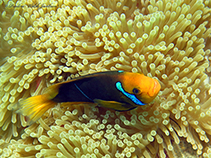
This species is distinguished by the following set of characters: D X-XI,17; A II 14-15, tubed lateral line scales 35-40; differs from A. chrysopterus, by the dorsal fin length (> 58% of SL in A. maohiensis vs. <56% of SL in A. chrysopterus), and using genetics, species can be unambiguously distinguished both with mitochondrial and nuclear genomic markers (reciprocally monophyletic clades). Colouration: when alive, adult with iris dark; body, light orange to dark yellow; two white to bluish bars, with the first behind the eye, the second midbody; all fins are orange (Ref. 137739).
Body shape (shape guide): short and / or deep; Cross section: compressed.
Found usually in association with Radianthus magnifica (= Heteractis magnifica), the magnificent sea anemone, which is also by very far the most common sea anemone in French Polynesia. Other less common sea anemone species may also be found and may be associated with this species, indicating no exclusive association with R. magnifica of this species (Ref. 137739).
), the magnificent sea anemone, which is also by very far the most common sea anemone in French Polynesia. Other less common sea anemone species may also be found and may be associated with this species, indicating no exclusive association with R. magnifica
วงจรชีวิตและพฤติกรรมการผสมพันธุ์
วัยเจริญพันธุ์ | การสืบพันธุ์ | การวางไข่ | เซลสืบพันธ์ของเพศเมีย(ไข่) | ความดกของไข่ | ตัวอ่อน
O'Donnell, J.L., R. Beldade, J. Johns and G. Bernardi, 2025. A new species of Anemonefish from French Polynesia, Amphiprion maohiensis, (Pomacentridae, Amphiprioninae), the Polynesian anemonefish. ZooKeys 1244:225-237. (Ref. 137739)
สถานะบัญชีแดงของ IUCN (Ref. 130435: Version 2025-2 (Global))
ภัยคุกคามต่อมนุษย์
Harmless
การใช้ของมนุษย์
การประมง: ผลประโยชน์ที่น่าจะเกิดขึ้น
เครื่องมือ
รายงานพิเศษ
ดาวน์โหลด XML
แหล่งที่มาจากอินเตอร์เน็ต
การประมาณค่าตามแบบจำลอง
ดัชนีความหลากหลายทางวิวัฒนาการ (อ้างอิง
82804): PD
50 = 0.5000 [Uniqueness, from 0.5 = low to 2.0 = high].
Bayesian length-weight: a=0.02344 (0.01149 - 0.04783), b=2.98 (2.80 - 3.16), in cm total length, based on LWR estimates for this (Sub)family-body shape (Ref.
93245).
ระดับชั้นอาหาร (อ้างอิง
69278): 2.7 ±0.3 se; based on size and trophs of closest relatives
ความสามารถในการกลับคืนสู่ปกติ (อ้างอิง
120179): ขนาดกลาง, เวลาต่ำสุดที่จะทำให้ประชากรเพิ่มขึ้นเป็น 2 เท่าใช้เวลา 1.4 - 4.4 ปี (Preliminary K or Fecundity.).
ความเสี่ยงต่อการตกปลา (Ref.
59153): Low vulnerability (10 of 100).
🛈