>
Perciformes/Scorpaenoidei (Scorpionfishes) >
Scorpaenidae (Scorpionfishes or rockfishes) > Scorpaeninae
Etymology: Neomerinthe: Greek, neos = new + Greek, merinthos, -ou = thread (Ref. 45335); ignea: Name 'ignea' from the Latin word meaning 'fiery', in reference to the body and tentacle
color when fresh.
Milieu: milieu / Klimaatzone / Diepte / verspreidingsgebied
Ecologie
marien demersaal; diepte 76 - 505 m (Ref. 137823). Subtropical
Western Pacific: Japan, Taiwan, Philippines, Indonesia, Solomon Is., Vanuatu, Wallis & Futuna, and New Caledonia.
Grootte / Gewicht / Leeftijd
Maturiteit: Lm ? range ? - ? cm
Max length : 8.9 cm SL mannelijk / geslacht onbekend; (Ref. 137823)
Korte beschrijving
Determinatiesleutels | Morfologie | Morfometrie
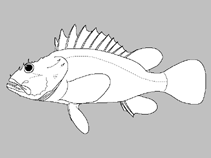
Dorsale stekels (totaal) : 12 - 13; Dorsale zachte stralen (totaal) : 9 - 10; Anale stekels: 3; Anale zachte stralen: 4 - 5. This species is distinguished from its congeners by the following set of characters: D 9 or 10 (usually 9); pectoral fin rays 17-19 (18); scale rows in longitudinal series 37-42 (38); pored lateral-line scales 23-25 (24); scale rows above lateral line 4-6 (5), below lateral line 9-11 (10), between sixth dorsal-fin spine base and lateral line 5 or 6 (5), and between last dorsal-fin spine base and lateral line 5-7 (5); upper gill rakers 5-7 (6), lower gill rakers 9-16 (13) [8-10 (9) and 0-7 (4) on ceratohyal and hypobranchial, respectively], Total gill rakers 16-22 (19); a longitudinal ridge usually present on lateral surface of maxilla; presence of lateral lacrimal spine; 3 suborbital spines; presence of second preopercular spine; minute slit behind last gill arch; many small cycloid scales on base of pectoral fin and ventral surface of body between isthmus and posterior to pelvic fin; first dorsal-fin ray length 14.7-19.1 (mean 17.3) % of SL; second dorsal-fin ray length 14.6-18.9 (17.3) % of SL; third dorsal fin ray length 15.6-18.9 (17.4) % of SL; fourth dorsal-fin ray length 15.2-19.1 (17.2) % of SL; fifth dorsal-fin ray length 14.2-19.5 (16.8) % of SL; body bright orange to reddish white when fresh; and pale yellowish body and pectoral fins, with indistinct blotches above lateral line when preserved (Ref. 137823).
Body shape (shape guide): fusiform / normal; Cross section: compressed.
Levenscyclus en paargedrag
Maturiteit | Voortplanting | Paaien | Eieren | Fecunditeit | Larven
Matsumoto, T., N. Muto and H. Matsumoto, 2023. Neomerinthe ignea, a new species of scorpionfish (Teleostei: Scorpaenidae) from the western Pacific Ocean, with a review of records of N. erostris (Alcock 1896). Ichthyol. Res. 71:317-332. (Ref. 137823)
Status op de Rode Lijst van het IUCN (Ref. 130435: Version 2025-2 (Global))
Gevaar voor de mens
Harmless
Gebruik door de mens
Visserij: van geen belang
Tools
Speciale rapporten
Download XML
Internetbronnen
Schattingen op basis van modellen
Fylogenetische diversiteitsindex (Ref.
82804): PD
50 = 0.5000 [Uniqueness, from 0.5 = low to 2.0 = high].
Bayesian length-weight: a=0.01288 (0.00626 - 0.02652), b=3.02 (2.85 - 3.19), in cm total length, based on LWR estimates for this (Sub)family-body shape (Ref.
93245).
Trofisch niveau (Ref.
69278): 3.6 ±0.6 se; based on size and trophs of closest relatives
Weerstandsvermogen (Ref.
120179): Hoog, minimale populatieverdubbelingstijd minder dan 15 maanden (Preliminary K or Fecundity.).
Kwetsbaarheid van de visserij (Ref.
59153): Low vulnerability (10 of 100).
🛈