Classificazione / Nomi
Nomi Comuni | Sinonimi | Catalog of Fishes(Genere, Specie) | ITIS | CoL | WoRMS | Cloffa
>
Beryciformes (Sawbellies) >
Cetomimidae (Flabby whalefishes)
Etymology: Cetomimus: Greek, ketos = a marine monster, whale + Greek, mimos, ou = imitator (Ref. 45335); paxtoni: Name 'paxtoni' in honor of a remarkable Australian ichthyologist, J.R. Paxton, for his contributions to the study of fishes of the family Cetomimidae.
Ambiente: milieu / zona climatica / distribuzione batimetrica / gamma di distribuzione
Ecologia
marino pelagico; distribuzione batimetrica 2680 - 3532 m (Ref. 137815). Tropical
Distribuzione
Territories | Aree FAO | Ecosistemi | Presenze | Mappa dei ritrovamenti | Introduzioni | Faunafri
Western Central Atlantic
Dimensione / Peso / Età
Maturità: Lm ? range ? - ? cm
Max length : 5.2 cm SL (female)
Breve descrizione
Chiavi di identificazione | Morfologia | Morfometria
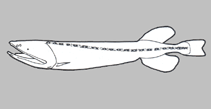
Raggi dorsali molli (totale) : 17 - 18; Raggi anali molli: 18; Vertebre: 42 - 48. This species is distinguished from its congeners by the following set of characters: 31/2 gill arches (withsmall slit behind the third gill arch); with cavernous tissue around the anus and above the bases of the first to sixth rays of the anal fin; absence of cavernous tissue in other parts of the body; presence of large pores of the lateral line canal, which are approximately as wide as this canal; absence of large valve-like triangular outgrowths along the margin of septa between the pores in the posterior part of the lateral line; with 42-48 vertebrae; with 20, 17-18, and 18 rays in the pectoral, dorsal, and anal fins, respectively; with 17-18 pores in the lateral line canal between the vertical of the upper margin of the gill cover and the end of the caudal peduncle; with a low body, the maximum depth of which is 15-16% SL; with a relatively narrow and long caudal peduncle, the height of which is about two times its width; with a medium-sized head 30-31% SL; and with a snout widely rounded in dorsal view and with an eye diameter and maxilla length of 6 and 84-87% of head length, respectively (Ref. 137815).
Body shape (shape guide): elongated; Cross section: compressed.
Ciclo vitale e comportamento di accoppiamento
Maturità | Riproduzione | Deposizione | Uova | Fecondità | Larve
Kobyliansky, S.G., N.V. Gordeeva and A.V. Mishin, 2023. A new whalefish species of the genus Cetomimus (Cetomimidae) from the Tropical part of the Central Atlantic. J. Ichthyol. 63(3):395-407. (Ref. 137815)
Stato della Lista Rossa IUCN (Ref. 130435: Version 2025-2 (Global))
Minaccia per l'uomo
Harmless
Usi umani
Pesca: di nessun interesse
Strumenti
Rapporti speciali
Scarica XML
Fonti Internet
Stime basate su modelli
Indice di diversità filogenetica (Fonte Biblio.
82804): PD
50 = 0.5039 [Uniqueness, from 0.5 = low to 2.0 = high].
Bayesian length-weight: a=0.00389 (0.00180 - 0.00842), b=3.12 (2.94 - 3.30), in cm total length, based on all LWR estimates for this body shape (Ref.
93245).
Resilienza (Fonte Biblio.
120179): Alto, tempo minimo di raddoppiamento della popolazione meno di 15 mesi (Preliminary K or Fecundity.).
Vulnerabilità della pesca (Ref.
59153): Low vulnerability (10 of 100).
🛈