Classification / Noms
Noms communs | Synonymes | Catalog of Fishes(Genre, Espèce) | ITIS | CoL | WoRMS | Cloffa
>
Anabantiformes (Gouramies, snakeheads) >
Badidae (Chameleonfishes)
Etymology: Dario: Bengali/Bangla: ‘Darhi’, local Bengali name for this species; ‘Darhi’ also means ‘beard' (Ref. 2031); melanogrammus: Named for the black zigzag lines typical of this species.
Environnement : milieu / zone climatique / profondeur / gamme de distribution
Écologie
; eau douce benthopélagique. Tropical
Asia: Myanmar.
Taille / Poids / Âge
Maturité: Lm ? range ? - ? cm
Max length : 2.2 cm SL mâle / non sexé; (Ref. 137632)
Description synthétique
Clés d'identification | Morphologie | Morphométrie
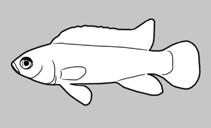
Épines dorsales (Total) : 14 - 16; Rayons mous dorsaux (Total) : 6 - 9; Épines anales: 3; Rayons mous anaux: 7 - 9; Vertèbres: 25 - 27. This small badid species, barely exceeding 2.0 cm SL, is distinguished from its congeners by the following characters: zigzagging bars, which are formed by darkly pigmented posterior scale margins involving usually three scale rows; among Myanmar species of Dario, further differs from D. hysginon and D. tigris by having more vertebrae modally 26 (vs. 25 in D. hysginon, 24 in D. tigris) and a genetic divergence of 15.6-19.0 % uncorrected p-distance in the COI gene (Ref. 137632).
Body shape (shape guide): fusiform / normal; Cross section: oval.
This species was collected from several localities along the Chindwin in the vicinity of Homalin, Htamanthi and Hkamti. At the type locality in Tarwa Chaung near Homalin, the water had a temperature of 24 °C, a pH of 6.7 and a conductivity of 20 μS on 23 Feb 2013;. There were no aquatic vegetation and the bottom was muddy with sand and gravel. Associated fish species co-occuring with this species include the following: Acanthocobitis rubidipinnis, Amblyceps sp., Badis ferrarisi, B. kyar, Channa sp., Danio htamanthinus, Danio sp., Devario annandalei, Esomus sp., Laubuka khujairokens, Lepidocephalichthys berdmorei, Mystus pulcher, Ompok sp., Olyra sp., Opsarius sp., Pethia thelys, P. meinganbii, Puntius chola, Rasbora ornata, R. daniconius, Schistura sp., and Trichogaster labiosa (Ref. 137632).
Cycle de vie et comportement reproducteur
Maturité | Reproduction | Frai | Œufs | Fécondité | Larves
Britz, R., S.O. Kullander and L. Rüber, 2022. Dario tigris and Dario melanogrammus, two new species of miniature chameleon fishes from northern Myanmar (Teleostei: Badidae). Zootaxa 5138(1):1-16. (Ref. 137632)
Statut dans la liste rouge de l'IUCN (Ref. 130435: Version 2025-2 (Global))
Menace pour l'homme
Harmless
Utilisations par l'homme
Pêcheries: sans intérêt
Outils
Articles particuliers
Télécharger en XML
Sources Internet
Estimations basées sur des modèles
Indice de diversité phylogénétique (Réf.
82804): PD
50 = 0.5020 [Uniqueness, from 0.5 = low to 2.0 = high].
Bayesian length-weight: a=0.01175 (0.00503 - 0.02745), b=2.93 (2.73 - 3.13), in cm total length, based on LWR estimates for this (Sub)family-body shape (Ref.
93245).
Niveau trophique (Réf.
69278): 3.1 ±0.4 se; based on size and trophs of closest relatives
Vulnérabilité de la pêche (Ref.
59153): Low vulnerability (10 of 100).
🛈