Classificazione / Nomi
Nomi Comuni | Sinonimi | Catalog of Fishes(Genere, Specie) | ITIS | CoL | WoRMS | Cloffa
>
Ovalentaria/misc (Various families in series Ovalentaria) >
Opistognathidae (Jawfishes)
Etymology: Stalix: Greek, stalix, -ikos = a stake used for holding nets (Ref. 45335); albonotata: Named for the fine white vermiculation on the body and the irregular white blotches on the dorsal fin of this species.
Ambiente: milieu / zona climatica / distribuzione batimetrica / gamma di distribuzione
Ecologia
marino associati a barriera corallina; distribuzione batimetrica 7 - 18 m (Ref. 137491). Temperate
Northwest Pacific: Japan (Ryukyu Is.).
Dimensione / Peso / Età
Maturità: Lm ? range ? - ? cm
Max length : 3.9 cm SL maschio/sesso non determinato; (Ref. 137491)
Breve descrizione
Chiavi di identificazione | Morfologia | Morfometria
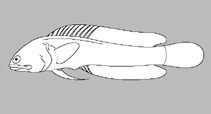
Spine dorsali (totale) : 11; Raggi dorsali molli (totale) : 11; Spine anali: 2; Raggi anali molli: 11. This species is distinguished by the following characters: D 11; pectoral fin 22-23; longitudinal scale rows 45-46; gill rakers on first gill arch of adults 15-16 + 25-26 = 40-42; orbit diameter 10.0-10.4 % of SL; sensory pores 2 (I4 and I5) present on the posterior half of the interorbital space; first 2 mandibular pores (M1 and M2) well-spaced, fifth pore (M5) with single opening;
lateral line terminating below the 2nd or 3rd dorsal-fin soft ray base (dorsal fin element 13 or 14); distal incision of 3rd to 5th dorsal-fin spines is moderate; anteroventral margin of upper lip crenulate. Colouration: body grayish-yellow, with fine brown and white vermiculations; lateral surface of the head grayish green, with rough gray vermiculation; dorsal-fin membrane is grayish-yellow, with several irregular white blotches when fresh; anterior gular region not pigmented (chin and area adjacent to anterior two mandibular pores with a few scattered melanophores (Ref. 137491).
Body shape (shape guide): elongated; Cross section: compressed.
Specimens were collected by handnet in an inner bay of the type locality with silty sand bottom. The paratype was also observed with five gobioids, Myersina nigrivirgata, Oplopomus oplopomus, Oxyurichthys papuensis, Taenioides kentalleni, and unidentified Tomiyamichthys species (Ref. 137491).
Ciclo vitale e comportamento di accoppiamento
Maturità | Riproduzione | Deposizione | Uova | Fecondità | Larve
Wada, H., T. Kobayashi, H. Suzuki and H. Senou, 2025. Two new jawfishes, Stalix albonotata sp. nov. and S. yanoi sp. nov., from the Ryukyu Islands, Japan (Perciformes: Opistognathidae). Bull. of the Kanagawa Prefectural Mus. (Natural Science) (54):205-217, (Ref. 137491)
Stato della Lista Rossa IUCN (Ref. 130435: Version 2025-2 (Global))
Minaccia per l'uomo
Harmless
Usi umani
Pesca: di nessun interesse
Strumenti
Rapporti speciali
Scarica XML
Fonti Internet
Stime basate su modelli
Indice di diversità filogenetica (Fonte Biblio.
82804): PD
50 = 0.5001 [Uniqueness, from 0.5 = low to 2.0 = high].
Bayesian length-weight: a=0.00389 (0.00180 - 0.00842), b=3.12 (2.94 - 3.30), in cm total length, based on all LWR estimates for this body shape (Ref.
93245).
Livello trofico (Fonte Biblio.
69278): 3.2 ±0.5 se; based on size and trophs of closest relatives
Vulnerabilità della pesca (Ref.
59153): Low vulnerability (10 of 100).
🛈