>
Perciformes/Uranoscopoidei (Sand dwellers) >
Pinguipedidae (Sandperches)
Etymology: Parapercis: Greek, para = the side of + Greek, perke = perch (Ref. 45335); imamurai: Named after Dr. Hisashi Imamura, Japan, in honour of his valuable contributions to the taxonomy
of pinguipedid fishes.
Eponymy: Dr Hisashi Imamura is a Japanese ichthyologist who has, for some years (since 2009), been Associate Professor of the Fisheries Science faculty at the Hokkaido University Museum, Hakodate, which institution awarded his PhD. [...] (Ref. 128868), visit book page.
Ambiente: milieu / zona climatica / distribuzione batimetrica / gamma di distribuzione
Ecologia
marino demersale; distribuzione batimetrica 256 - 405 m (Ref. 117414). Tropical
West Pacific: Australia.
Dimensione / Peso / Età
Maturità: Lm ? range ? - ? cm
Max length : 20.8 cm SL maschio/sesso non determinato; (Ref. 117414)
Breve descrizione
Chiavi di identificazione | Morfologia | Morfometria
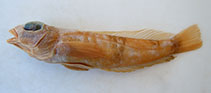
Spine dorsali (totale) : 5; Raggi dorsali molli (totale) : 21; Spine anali: 1; Raggi anali molli: 17; Vertebre: 29. This species is distinguished by the following characters: D V,21, fifth dorsal-fin spine longest; ; A I,17; pectoral-fin rays 19-20 (usually 19); lateral-line scales 55-58 (modally 57); gill rakers 5-7 + 11-12 = 16-18 (modally 17); ctenoid predorsal scales 10-12, extending forward to or just anterior to vertical from upper corner of preopercle; ctenoid scales on cheek, except for some small cycloid scales anteriorly near lower margin of suborbital region, extending forward to tip of maxilla in adults, slightly further forward in juveniles; canine teeth 10 in outer row at front of lower jaw; vomer in adults with 3 rows of robust conical teeth (2 rows in some juveniles); no palatine teeth; hind margin of preopercle usually entire, angle with 2-4 low blunt serrations in adults, and more robust pointed spines in some juveniles; angle of subopercle with single broad, flattened spine; vertebrae, abdominal 10; caudal 19; adults with pelvic fins reaching vent, slightly beyond vent in juveniles. Colouration: pale brownish pink, with broad diffuse dusky bar from lower margin of eye across the suborbital region, three broad diffuse dusky bands across the body and caudal-fin base, the first on soft dorsal fin below base of dorsal-fin rays 6-11, second below base of dorsal-fin rays 15-19, third from posterior portion of caudal peduncle extending onto caudal-fin base; bands are distinct in juveniles, becoming more faint with growth; juveniles with large black blotch in lower half of soft dorsal fin between rays 6-9 and 16-18; anal fin black, the pigmentation on fins reducing with growth, faint or absent in large specimen (Ref. 117414).
Body shape (shape guide): elongated; Cross section: oval.
Collected from soft to rubbly bottom by demersal trawl, at depths of 256-405 m (Ref. 117414).
Ciclo vitale e comportamento di accoppiamento
Maturità | Riproduzione | Deposizione | Uova | Fecondità | Larve
Johnson, J.W. and J.W. Wilmer, 2018. Three new species of Parapercis (Perciformes: Pinguipedidae) and first records of P. muronis (Tanaka, 1918) and P. rubromaculata Ho, Chang & Shao, 2012 from Australia. Zootaxa 4388(2). (Ref. 117414)
Stato della Lista Rossa IUCN (Ref. 130435: Version 2025-2 (Global))
Minaccia per l'uomo
Harmless
Usi umani
Pesca: di nessun interesse
Strumenti
Rapporti speciali
Scarica XML
Fonti Internet
Stime basate su modelli
Indice di diversità filogenetica (Fonte Biblio.
82804): PD
50 = 0.5000 [Uniqueness, from 0.5 = low to 2.0 = high].
Bayesian length-weight: a=0.00692 (0.00314 - 0.01524), b=3.06 (2.88 - 3.24), in cm total length, based on LWR estimates for this Genus-body shape (Ref.
93245).
Livello trofico (Fonte Biblio.
69278): 3.6 ±0.4 se; based on size and trophs of closest relatives
Resilienza (Fonte Biblio.
120179): Medio, tempo minimo di raddoppiamento della popolazione 1.4 - 4.4 anni (Preliminary K or Fecundity.).
Vulnerabilità della pesca (Ref.
59153): Low vulnerability (15 of 100).
🛈