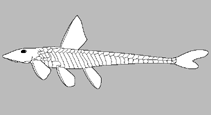
Classification / Noms
Noms communs | Synonymes | Catalog of Fishes(Genre, Espèce) | ITIS | CoL | WoRMS | Cloffa
>
Siluriformes (Catfishes) >
Loricariidae (Armored catfishes) > Hypostominae
Etymology: Hypostomus: Greek, hypo = under + Greek, stoma = mouth (Ref. 45335); sertanejo: Name derived from the Portuguese word for a person from the sertão (Sertão refers to the inland xerophitic region of north-eastern Brazil that is isolated from urban centres and associated with the Caatinga and the Cerrado biomes. Sertanejos are known to be shy and elusive as well as rustic and resilient; noun in apposition.
Environnement : milieu / zone climatique / profondeur / gamme de distribution
Écologie
; eau douce démersal. Tropical
South America: Brazil.
Taille / Poids / Âge
Maturité: Lm ? range ? - ? cm
Max length : 18.9 cm SL mâle / non sexé; (Ref. 118214)
Description synthétique
Clés d'identification | Morphologie | Morphométrie
Épines dorsales (Total) : 2; Rayons mous dorsaux (Total) : 7; Rayons mous anaux: 4. This species is distinguished by the following characters: fins and dermal-plated regions of head and body with pale spots or vermiculations on darker background; the caudal peduncle is laterally rounded; teeth slender and numerous, 34-75 on dentary and premaxilla; dorsal-fin spine when depressed not reaching the adipose-fin spine; pectoral-fin spine is longer than unbranched pelvic-fin ray; dorsal-fin with 7 branched rays; one predorsal plate (rarely 2) bordering the supraoccipital; teeth bicuspid asymmetrical (Ref. 118214).
Cross section: oval.
Known from Rio Jaguaribe basin and in nearby Rio Choró, where most records are from the Rio Salgado, a tributary of the Jaguaribe. These rivers are intermittent with clear water, with rock and sand and variable remnants of riparian vegetation. Its native occurrence in the Rio Choró is questionable due to an artificial channel linking it to the Rio Jaguaribe that was opened in October 1993. It occurs sympatrically with loricariids Loricariichthys derbyi, Parotocinclus cearensis, Parotocinclus jumbo, Parotocinclus spilurus, Pseudancistrus genisetiger. Other associated species include Leporinus taeniatus, Astyanax aff. fasciatus, Hemigrammus marginatus, Hemigrammus sp., Moenkhausia costae, Moenkhausia intermedia, Serrasalmus rhombeus, Tetragonopterus argenteus, Serrapinnus heterodon, Serrapinnus piaba, Hoplias malabaricus, Pimelodella dorseyi, Cichlasoma orientale, Crenicichla menezesi and the invasive cichlid Oreochromis niloticus (Ref. 118214).
Cycle de vie et comportement reproducteur
Maturité | Reproduction | Frai | Œufs | Fécondité | Larves
Zawadzki, C.H., T.P.A. Ramos and M. Sabaj, 2017. Hypostomus sertanejo (Siluriformes: Loricariidae), new armoured catfish species from north-eastern Brazil. J. Fish Biol. 91(1):317-330. (Ref. 118214)
Statut dans la liste rouge de l'IUCN (Ref. 130435: Version 2025-2 (Global))
Menace pour l'homme
Harmless
Utilisations par l'homme
Pêcheries: sans intérêt
Outils
Articles particuliers
Télécharger en XML
Sources Internet
Estimations basées sur des modèles
Indice de diversité phylogénétique (Réf.
82804): PD
50 = 0.5000 [Uniqueness, from 0.5 = low to 2.0 = high].
Bayesian length-weight: a=0.01585 (0.00726 - 0.03460), b=2.95 (2.78 - 3.12), in cm total length, based on LWR estimates for this Genus-body shape (Ref.
93245).
Résilience (Réf.
120179): Milieu, temps minimum de doublement de population : 1,4 à 4,4 années (Preliminary K or Fecundity.).
Vulnérabilité de la pêche (Ref.
59153): Low vulnerability (13 of 100).
🛈