>
Carangiformes (Jacks) >
Carangidae (Jacks and pompanos) > Caranginae
Etymology: Caranx: French, carangue, the name of a Caribbean fish; 1836 (Ref. 45335).
More on author: Linnaeus.
Môi trường: môi trường / vùng khí hậu / Mức độ sâu / phạm vi phân phối
Sinh thái học
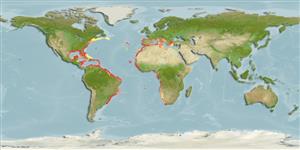
biển; thuộc về nước lợ pelagic-neritic; Ở đại duơng, biển (Ref. 51243); mức độ sâu 1 - 350 m (Ref. 7097), usually 1 - 200 m (Ref. 55173). Subtropical
Atlantic Ocean, restricted to continental shelf areas. Mediterranean excluded.
Chiều dài lúc trưởng thành đầu tiên / Bộ gần gũi / Khối lượng (Trọng lượng) / Tuổi
Chín muồi sinh dục: Lm 66.0 range ? - ? cm
Max length : 124 cm TL con đực/không giới tính; (Ref. 5217); common length : 75.0 cm TL con đực/không giới tính; (Ref. 2683); Khối lượng cực đại được công bố: 32.0 kg (Ref. 27584)
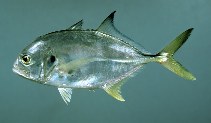
Các tia vây lưng cứng (tổng cộng) : 9; Các vây lưng mềm (tổng cộng) : 19 - 22; Tia cứng vây hậu môn: 3; Tia mềm vây hậu môn: 15 - 18. Diagnosis: Scutes on lateral line 23 (Ref. 57392) to 42 (Ref. 13442). No scales on chest (Ref. 13442), except a small mid-ventral patch in front of pelvic fins (Ref. 13442, 57392). Upper profile of head steep (Ref. 13442). Maxilla ending approximately below (Ref. 13442, 57392) or beyond (Ref. 57392) posterior edge of eye (in adult). Front of soft dorsal and anal fins elevated; olivaceous to bluish green dorsally, silvery to brassy on the sides; prominent black spot posteriorly on gill cover at level of eye, another at upper axil of pectoral fins, and often a third on lower pectoral rays; caudal yellowish (Ref. 13442).
Body shape (shape guide): fusiform / normal.
Generally in neritic waters over the continental shelf (Ref. 5217), from the coastline, where it is common on shallow flats, to offshore waters (Ref. 57392). Adults ascend rivers (Ref. 26938). Juveniles abundant in brackish estuaries with muddy bottoms, near sandy beaches and on seagrass beds (Ref. 5217), entering lagoons and lower courses of rivers (Ref. 57392). They form fast-moving schools, although larger fish may be solitary. They feed on smaller fish, shrimp, and other invertebrates (Ref. 5521). Often grunts or croaks are heard when caught. Eggs are pelagic (Ref. 4233).
Smith-Vaniz, W.F. and K.E. Carpenter, 2007. Review of the crevalle jacks, Caranx hippos complex (Teleostei: Carangidae), with a description of a new species from West Africa. Fish. Bull. 105(2):207-233. (Ref. 58464)
Tình trạng Sách đỏ IUCN (Ref. 130435: Version 2025-2 (Global))
Mối đe dọa đối với con người
Reports of ciguatera poisoning (Ref. 4690)
Sử dụng của con người
Các nghề cá: tính thương mại; cá để chơi: đúng
Các công cụ
Báo cáo đặc biệt
Tải xuống XML
Các nguồn internet
Ước tính dựa trên mô hình
Nhiệt độ ưa thích (Tài liệu tham khảo
123201): 16.5 - 27.9, mean 24.8 °C (based on 2020 cells).
Chỉ số đa dạng phát sinh loài (Tài liệu tham khảo
82804): PD
50 = 0.5000 [Uniqueness, from 0.5 = low to 2.0 = high].
Bayesian length-weight: a=0.01622 (0.01360 - 0.01934), b=2.96 (2.93 - 2.99), in cm total length, based on LWR estimates for this species (Ref.
93245).
Mức dinh dưỡng (Tài liệu tham khảo
69278): 3.6 ±0.4 se; based on diet studies.
Generation time: 3.1 ( na - na) years. Estimated as median ln(3)/K based on 1
growth studies.
Thích nghi nhanh (Tài liệu tham khảo
120179): Trung bình, thời gian nhân đôi của chủng quần tối thiểu là 1.4 - 4.4 năm (K=0.35; assumed tm=2).
Prior r = 0.53, 95% CL = 0.35 - 0.80, Based on 5 data-limited stock assessments.
Sự dễ bị tổn thương của nghề đánh cá (Ref.
59153): Moderate vulnerability (41 of 100).
🛈
Sự dễ bị tổn thương của khí hậu (Ref.
125649): High vulnerability (62 of 100).
🛈
Chất dinh dưỡng (Ref.
124155): Calcium = 10.9 [4.1, 19.9] mg/100g; Iron = 0.33 [0.17, 0.68] mg/100g; Protein = 20.9 [18.7, 23.4] %; Omega3 = 0.218 [0.121, 0.391] g/100g; Selenium = 33.8 [14.2, 84.4] μg/100g; VitaminA = 16 [5, 56] μg/100g; Zinc = 0.357 [0.217, 0.574] mg/100g (wet weight); based on
nutrient studies.