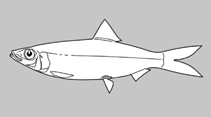
分類 / 名前
共通名の | 類義語 | Catalog of Fishes(部類, 種) | ITIS | CoL | WoRMS | Cloffa
>
Clupeiformes (Herrings) >
Dussumieriidae (Round herrings)
Etymology: Dussumieria: In honor of Dussumier, a collaborator of Cuvier, who sent him collections of fishes from the Indian Ocean (Ref. 45335); apollo: Name 'apollo' from Greek god Apollo, the guardian deity of the sun, in reference to its shiny body. Name in apposition.
Eponymy: Jean-Jacques Dussumier (1792–1883) was a French merchant, collector, traveller and ship owner. [...] (Ref. 128868), visit book page.
環境:環境 / 気候帯 / 深さの範囲 / 分布範囲
生態学
海 pelagic-neritic; 深さの範囲 10 - 55 m (Ref. 133004). Tropical
Indo-West Pacific: Papua New Guinea and Australia.
サイズ / 重さ / 年齢
成熟: Lm ? range ? - ? cm
Max length : 13.6 cm SL オス/雌雄の選別がない; (Ref. 133004)
簡単な記述
検索表 | 形態学 | 形態計測学
背鰭 (合計) : 20; 臀鰭: 15; 脊つい: 54. This species is distinguished by the following set of characters: body scales with numerous longitudinal striae on posterior part; numerous conical teeth on anterior parts of palatine and pterygoids, forming tooth band; absence of teeth on parasphenoid (rarely present); body comparatively deep, 21.9-23.9% of SL; scale rows in longitudinal series 49-52 (modally 49); vertebrae 53-56 (54); pseudobranchial filaments 17-21 (19); 1UGR 12-15 (13); 1LGR 22-27 (25); 1TGR 35-41 (38); 2UGR 7-10 (8); 2LGR 19-24 (21); 2TGR 27-34 (31); 3UGR 6-9 (7); 3LGR 14-17 (15); 3TGR 21-25 (22); 4UGR 3-6 (5); 4LGR 9-11 (10); 4TGR 13-16 (14); branchiostegal rays 12-16 (13); melanophores scattered on 5th to 9th pectoral-fin rays, counted from uppermost ray; maxilla length 8.7-9.5% of SL (mean 9.1%); mandibular length 13.4-14.5% of SL (13.8%); pre-dorsal-fin length 56.0-58.8% of SL (57.1%) (Ref. 133004).
Body shape (shape guide): fusiform / normal; Cross section: compressed.
ライフサイクルと交尾行動
成熟 | 繁殖 | 放精 | 卵 | 生産力 | 幼生
Hata, H., S. Lavoué, S.A. Appleyard and J.J. Pogonoski, 2025. A new species of Rainbow sardine in the genus Dussumieria (Teleostei: Clupeiformes: Dussumieriidae) from New Guinea and Australia. Ichthyol. Herpetol. 113(1):8-20. (Ref. 133004)
IUCNのレッドリストの状況は (Ref. 130435: Version 2025-2 (Global))
人間の用途
水産業: 興味がない
用具
特記事項
XMLをダウンロードして下さい
インターネットの情報源
モデルに基づく推定値
系統多様性指数 (参照
82804): PD
50 = 0.5020 [Uniqueness, from 0.5 = low to 2.0 = high].
Bayesian length-weight: a=0.00933 (0.00426 - 0.02047), b=3.03 (2.84 - 3.22), in cm total length, based on LWR estimates for this (Sub)family-body shape (Ref.
93245).
栄養段階 (参照
69278): 3.4 ±0.4 se; based on size and trophs of closest relatives
回復力 (参照
120179): 高い, 15か月以下の倍増期間の最小個体群 (Preliminary K or Fecundity.).
漁業の脆弱性 (Ref.
59153): Low vulnerability (10 of 100).
🛈