分類 / 名前
共通名の | 類義語 | Catalog of Fishes(部類, 種) | ITIS | CoL | WoRMS | Cloffa
>
Characiformes (Characins) >
Serrasalmidae (Piranhas and pacus) > Serrasalminae
Etymology: Serrasalmus: Latin, serran, serranus, saw and a fish of genus Serranus + Latin, salmo = salmon (Ref. 45335); magallanesi: Named in honor and memoriam of Frank Magallanes, in recognition of his permanent collaboration with ichthyologists and Serrasalmus fans, mainly through his website OPEFE (https://www.opefe.com).
環境:環境 / 気候帯 / 深さの範囲 / 分布範囲
生態学
; 新鮮な水 底生の漂泳性. Tropical
South America: Amazon basin, Bolivia.
サイズ / 重さ / 年齢
成熟: Lm ? range ? - ? cm
Max length : 15.7 cm SL オス/雌雄の選別がない; (Ref. 132507)
簡単な記述
検索表 | 形態学 | 形態計測学
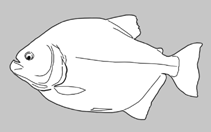
This species is distinguished from its congeners by the following characters: differs from S. hollandi by the absence of humeral spot (vs. dark humeral spot); snout oblique (vs. blunt), pored lateral-line scales 75-78 (vs. 83–88), last post-ventral serrae to first anal-fin ray distance 5-7% of HL (vs. 12-20% of HL), second supraneural length 23-31 of HL (vs. 34-42% of HL), supraoccipital to pre-dorsal spine distance 26-28% of SL (vs. 20-22% of SL), lower edge of the operculum yellow or orange (vs. lower edge of the operculum red), pre-dorsal zone silver (vs. darkish predorsal zone), ventral zone silver (vs. reddish ventral zone); differs from S. compressus by having dark basal portion of caudal-fin (vs. dark well-defined vertical terminal band), anal-fin red with dark distal edge (vs. darkish anal-fin) in life, dorsal-fin origin to anal-fin origin distance 49-59% of SL (vs. 61-66%), body depth 50-60% of SL (vs. 64-68%), longitudinal scale rows from the lateral-line to dorsal-fin origin 30-33 (vs. 34-37), cleithrum to eighth pre-pelvic serrae distance 22-25% of HL (vs. 30-37%), second supraneural length 23-31% of HL (vs. 35-42%), supraoccipital to last vertebra of the Weberian apparatus distance 39-42% of HL (vs. 43-49% of HL), high tip of the premaxilla to supraoccipital distance 30-31% of SL (vs. 43-49%), body depth XR 52-54% of SL (vs. 59-64%), low tip of the premaxilla (LTP) to supraoccipital distance 37-39% of SL (vs. 40-43%), second dorsal height 16-17% of SL (vs. 20-21%), premaxilla height 20-22% of HL (vs. 17-19%); differs from S. odyssei by having a dark basal portion of caudal-fin (vs. dark edge in caudal-fin with translucent sub-terminal portion), total pored lateral-line scales 75-78 (vs. 80-86), last post-ventral serrae to first anal-fin ray distance 5-7% of HL (vs. 11-16% of HL), fourth supraneural length 29-30% of HL (vs. 33-35%), body depth radiography 52-54% of SL (vs. 45-49%), LTP to supraoccipital distance 37-39% of SL (vs. 33-36%), supraoccipital to pre-dorsal spine distance 26-28% of SL (vs. 22-24%); differs from S. rhombeus by the dark basal portion of caudal-fin (vs. dark well-defined vertical terminal band), anal-fin red with dark distal edge (vs. anal-fin with dark vertical terminal band) when alive, total pored lateral line scales 75-78 (vs. 84-90), last post-ventral serrae to first anal-fin ray distance 5-7% of HL (vs. 14-15%), low tip of the premaxilla to supraoccipital distance 37-39% of SL (vs. 32-36%), distance of supraoccipital to pre-dorsal spine 26-28 of SL (vs. 20-24% of SL); differs from S. spilopleura by the round or oval spots on the dorsal flanks of equal or smaller diameter than the pupil, not large (vs. no spots on flanks), dark basal portion of caudal-fin (vs. dark caudal with diffuse edge), inter-orbital distance 30-46% of HL (vs. 50-54%), total pored lateral-line scales 75-78 (vs. 80-86), last post-ventral serrae to first anal-fin ray distance 5-7% of HL (vs. 9-16%), second supraneural length 23-31% of HL (vs. 43-44%); differs from S. maculatus by having a silver colored body (vs. yellowish) when alive, anal-fin red with dark distal edge (vs. yellowish), dark basal portion of caudal-fin (vs. caudal-fin with dark sub-terminal vertical band and a translucent vertical terminal band), total pored lateral-line scales 75-78 (vs. 80-86); differs from S. elongatus by having round to oval spots on the dorsal flanks of equal or smaller diameter than the pupil, not large (vs. small spots on the flanks forming vertical zigzag lines on flanks), anal-fin red with dark distal edge (vs. darkish anal-fin), post-occipital distance 34-39% of SL (vs. 29-33%), base of dorsal-fin 18-22% of SL (vs. 15-17%), anal-fin base 33-41% of SL (vs. 26-31%), pectoral-fin to dorsal-fin distance 46-56% of SL (vs. 36-42%), ventral-fin to dorsal-fin distance 44-65% of SL (vs. 34-41%), dorsal-fin origin to anal-fin origin distance 49-59% of SL (vs. 37-44%), end of dorsal-fin to anal-fin origin distance 40-49% of SL (vs. 28-35%), body depth 50-60% of SL (vs. 36-42%), total pored lateral-line scales 75-78 (vs. 86-100); differs from S. marginatus by having dark basal portion of caudal-fin (vs. dark basal part of caudal-fin with a dark thin vertical terminal band, but in some cases, it can have a faint vertical terminal band), lower edge of the operculum yellow or orange (vs. silver) in life, anal-fin red with dark distal edge (vs. yellowish), last post-ventral serrae to pre-anal spine distance 9-14% of HL (vs. 4-8%), fourth supraneural length 29-30% of HL (vs. 31-42%) (Ref. 132507).
Cross section: compressed.
Inhabits streams and lagoons of fluvial (meandric) and of tectonic origin in white and clear water systems that run through the lowlands of the Bolivian Amazon basin, upper Madeira River system (Ref. 132507).
ライフサイクルと交尾行動
成熟 | 繁殖 | 放精 | 卵 | 生産力 | 幼生
Gallo-Cardozo, F., M. Maldonado, M. Careaga and F. M. Carvajal-Vallejos, 2024. A new species of piranha (Serrasalmus, Serrasalmidae) from the upper Madeira River system, Amazon basin, Bolivia. J. Ichthyol. 64(3):386-409. (Ref. 132507)
IUCNのレッドリストの状況は (Ref. 130435: Version 2025-2 (Global))
人間の用途
用具
特記事項
XMLをダウンロードして下さい
インターネットの情報源
モデルに基づく推定値
系統多様性指数 (参照
82804): PD
50 = 0.5000 [Uniqueness, from 0.5 = low to 2.0 = high].
Bayesian length-weight: a=0.01380 (0.00641 - 0.02973), b=3.16 (2.99 - 3.33), in cm total length, based on LWR estimates for this Genus-body shape (Ref.
93245).
栄養段階 (参照
69278): 3.5 ±0.6 se; based on size and trophs of closest relatives
回復力 (参照
120179): 高い, 15か月以下の倍増期間の最小個体群 (Preliminary K or Fecundity.).
漁業の脆弱性 (Ref.
59153): Low vulnerability (10 of 100).
🛈