Klassifizierung / Names
Namen | Synonyme | Catalog of Fishes(Gattung, Arten) | ITIS | CoL | WoRMS | Cloffa
Elasmobranchii (Haie und Rochen) (sharks and rays) >
Carcharhiniformes (Ground sharks) >
Sphyrnidae (Hammerhead, bonnethead, or scoophead sharks)
Etymology: Sphyrna: Probable misspelling of sphyra (Gr.), hammer, referring to their hammer-shaped heads (See ETYFish); alleni: Named after Paul G. Allen (1953-2018) who was an investor, co-founder of Microsoft, and philanthropist who, through the Paul G. Allen Family Foundation, has generously supported shark
research and conservation.
Umwelt: Milieu / Klimazone / Tiefenbereich / Verbreitungsgebiet
Ökologie
seewasser; brackwasser riff-verbunden. Tropical
Western Pacific: Belize to Brazil; including Panama, Colombia, Trinidad and Tobago. S. tiburo from North Carolina, U.S to Belize have potential contact zone with S. alleni between Mexico and Belize (Yucatan Peninsula).
Größe / Gewicht / Alter
Geschlechtsreife: Lm ? range ? - ? cm
Max length : 6.5 cm TL Männchen/unbestimmt; (Ref. 132488); 10.3 cm TL (female)
Kurzbeschreibung
Bestimmungsschlüssel | Morphologie | Morphometrie
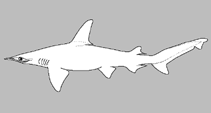
This small hammerhead shark (<150 cm at maturity) is distinguished by the following characters: a flat, shovel shaped head without indentations on its anterior edge; cephalofoil anterior margin is pointed (like a triangle) in both sexes and the posterior margins are lobule shaped; anterior margin of males exhibits a pronounced bulge; with enlarged, molariform posterior teeth, the first
dorsal rear tip in front of pelvic origins, and shallowly concave posterior anal margin.; differs from S. tiburo with anterior margin of the head more rounded and the lobules on the posterior margin are not present; precaudal vertebral counts 80-83 (ca.10 more vertebrae than S. tiburo) (Ref. 132488).
Cross section: oval.
Occurs in coastal waters, estuaries, coral reefs, seagrass beds, and sand bottoms (Ref. 132488).
Lebenszyklus und Paarungsverhalten
Geschlechtsreife | Fortpflanzung | Ablaichen | Eier | Fruchtbarkeit | Larven
Gonzalez, C., B. Postaire, W. Driggers, S. Caballero and D, Chapman, 2024. Sphyrna alleni sp. nov., a new hammerhead shark (Carcharhiniformes, Sphyrnidae) from the Caribbean and the Southwest Atlantic. Zootaxa 5512(4):491-511. (Ref. 132488)
IUCN Rote Liste Status (Ref. 130435: Version 2025-2 (Global))
Bedrohung für Menschen
Harmless
Nutzung durch Menschen
Tools
Zusatzinformationen
Download XML
Internet Quellen
Schätzungen auf der Grundlage von Modellen
Phylogenetischer Diversitätsindex (Ref.
82804): PD
50 = 0.5006 [Uniqueness, from 0.5 = low to 2.0 = high].
Bayesian length-weight: a=0.00355 (0.00159 - 0.00792), b=3.12 (2.93 - 3.31), in cm total length, based on LWR estimates for this (Sub)family-body shape (Ref.
93245).
Trophische Ebene (Ref.
69278): 3.4 ±0.4 se; based on size and trophs of closest relatives
Widerstandsfähigkeit (Ref.
120179): hoch, Verdopplung der Population dauert weniger als 15 Monate. (Preliminary K or Fecundity.).
Anfälligkeit der Fischerei (Ref.
59153): Low vulnerability (10 of 100).
🛈