>
Siluriformes (Catfishes) >
Auchenoglanididae (Flatnose catfishes)
Etymology: Parauchenoglanis: Greek, para = near + Greek, auchen = neck + Greek, glanis = a fish that can eat the bait without touching the hook; a cat fish (Ref. 45335); chiumbeensis: Named after its type locality Chiumbe River, Kasai sub-basin, Angola, the suffix ‘-ensis’, meaning ‘lives in’, has been added.
Περιβάλλον: περιβάλλον / κλιματική ζώνη / εύρος βάθους / εύρος διανομής
Οικολογία
; Γλυκού νερού βενθοπελαγικό. Tropical
Africa: Angola.
Μέγεθος / Βάρος / Ηλικία
Γεννητική Ωρίμανση: Lm ? range ? - ? cm
Max length : 14.3 cm SL αρσενικό/απροσδιόριστο; (Ref. 132425)
Σύντομη περιγραφή
Κλείδες προσδιορισμού | Μορφολογία | Μορφομετρία
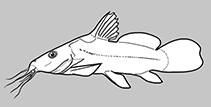
Μαλακές ραχιαίες ακτίνες (συνολικά) : 7; Μαλακές εδρικές ακτίνες: 8 - 10; Σπόνδυλοι: 36 - 37. This species is distinguished from its congeners ahli, altipinnis, balayi, buettikoferi, longiceps, monkei, pantherinus, punctatus by a broad humeral process (vs. pointed humeral process); differs further from altipinnis, balayi, pantherinus, punctatus by its coarse skin (vs. smooth); differs from zebratus by its humeral process clearly visible through the skin and anterior margin of the pectoral-fin spine mostly smooth (vs. humeral process embedded under the skin and anterior margin of the pectoral-fin spine mostly serrated); differs from stiassnyae by its truncated caudal fin (vs. rounded), dorsolaterally positioned eyes (vs. dorsally positioned), and the presence of regularly spaced vertical rows of spots on the flank (vs. irregularly spaced blotches); differs from ngamensis, lueleensis, poikilos, ernstswartzi, megalasma by the absence of background spots (vs. present in ngamensis, lueleensis, poikilos, or vermiculated pattern in ernstswartzi, or blotches in megalasma);
differs further from lueleensis, poikilos, ernstswartzi, megalasma by the relative long interdorsal-adipose distance, 6.3%-12.7% SL (vs. narrow interdorsal-adipose distance, 3.7%-6.8% SL in lueleensis, 5.5%-5.8% SL in poikilos, 3.8%-5.0% SL in ernstswartzi, and 3.9%-4.8% SL in megalasma); differs further from ernstswartzi, megalasma by its vertical rows of spots (vs. vertical rows of blotches in ernstswartzi, megalasma); differs from luendaensis by its faintly spotted fins (vs. unspotted); differs further from poikilos by its shorter prepectoral fin length, 26.7%-29.5% SL (vs. longer, 30.6%-31.4% SL); differs further from poikilos, megalasma by having a
shorter adipose fin, 26.0%-34.9% SL (vs. longer, 36.0%-36.6% SL in poikilos and 35.6%-36.9% SL in megalasma); differs further from dolichorhinus by its deeper body, 14.8%-21.3% SL (vs. shallow, 11.6%-14.0% SL) (Ref. 132425).
Cross section: oval.
Κύκλος ζωής και συμπεριφορά ζευγαρώματος
Γεννητική Ωρίμανση | Αναπαραγωγή | Γεννοβολία | Αβγά | Γονιμότητα | Προνύμφες
Sithole, Y., E.J.W.M.N. Vreven, P.H.N. Bragança, T. Musschoot and A. Chakona, 2024. Nine in one: integrative taxonomic evidence of hidden species diversity in the widespread Zambezi grunter, Parauchenoglanis ngamensis (Siluriformes: Auchenoglanididae), from southern and south-central Africa. Zool. J. Linn. Soc. 202:1-33. (Ref. 132425)
Κατάσταση Κόκκινου Καταλόγου IUCN (Ref. 130435: Version 2025-2 (Global))
Απειλή για τον άνθρωπο
Harmless
Ανθρώπινες χρήσεις
αλιεία: περιορισμένης εμπορικότητας
Εργαλεία
Ειδικές εκθέσεις
Λήψη XML
Διαδικτυακές πηγές
Εκτιμήσεις βάσει μοντέλων
Δείκτης φυλογενετικής ποικιλότητας (Αναφ.
82804): PD
50 = 0.5000 [Uniqueness, from 0.5 = low to 2.0 = high].
Bayesian length-weight: a=0.00525 (0.00219 - 0.01260), b=3.09 (2.87 - 3.31), in cm total length, based on LWR estimates for this (Sub)family-body shape (Ref.
93245).
Τροφικό Επίπεδο (Αναφ.
69278): 3.5 ±0.6 se; based on size and trophs of closest relatives
Ελαστικότητα (Αναφ.
120179): Υψηλό, ελάχιστος χρόνος για διπλασιασμό πληθυσμού < 15 μήνες (Preliminary K or Fecundity.).
Ευπάθεια στην αλιεία (Ref.
59153): Low vulnerability (10 of 100).
🛈