>
Siluriformes (Catfishes) >
Auchenoglanididae (Flatnose catfishes)
Etymology: Parauchenoglanis: Greek, para = near + Greek, auchen = neck + Greek, glanis = a fish that can eat the bait without touching the hook; a cat fish (Ref. 45335); megalasma: Name from Greek ‘megalasma’ derived from ‘mega’ meaning large and ‘melasma’ meaning black spot, referring to the distinct large blotches along the lateral line present in this species.
Ambiente: milieu / zona climatica / distribuzione batimetrica / gamma di distribuzione
Ecologia
; acqua dolce benthopelagico. Tropical
Africa: Angola.
Dimensione / Peso / Età
Maturità: Lm ? range ? - ? cm
Max length : 7.3 cm SL maschio/sesso non determinato; (Ref. 132425)
Breve descrizione
Chiavi di identificazione | Morfologia | Morfometria
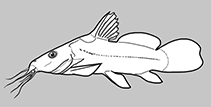
Raggi dorsali molli (totale) : 7; Raggi anali molli: 9; Vertebre: 32 - 33. This species is distinguished from its congeners ahli, altipinnis, balayi, buettikoferi, longiceps, monkei, pantherinus, punctatus by the presence of vertical rows of blotches (vs. vertical rows of spots or bands in monkei, zebratus) and further differs from these species by a partly round snout (vs. bluntly triangular); differs from stiassnyae with truncated caudal fin (vs. rounded), dorsolaterally positioned eyes (vs. dorsally), and spotted fins (vs. unspotted pectoral, pelvic, and anal fins); it differs from all other species except ernstswartzi by its body having vertical rows of blotches with smaller blotches between them (vs. body with vertical rows of spots or bars and spots between them in ngamensis, lueleensis or absent background spots in patersoni, dolichorhinus, luendaensis, chiumbeensis); differs further differentiated from ernstswartzi by the vertical rows of blotches not extending onto adipose fin (vs. rows extending onto adipose fin), eyes situated dorsolaterally (vs. eyes situated dorsally), and deeper body depth, 18.2%-19.9% SL (vs. shallow body depth, 15.0%-17.4% SL); differs luendaensis by the spotted head and fins (vs. unspotted); differs further from luendaensis, chiumbeensis by the relatively long predorsal length, 40.7%-41.9% SL (vs. shorter, 37.9%-40.1% SL in luendaensisand 35.6%-40.8% SL in chiumbeensis); differs further chiumbeensis by its longer adipose fin, 35.6%-36.9% SL (vs. shorter, 26.0%-34.9% SL) (Ref. 132425).
Cross section: oval.
Ciclo vitale e comportamento di accoppiamento
Maturità | Riproduzione | Deposizione | Uova | Fecondità | Larve
Sithole, Y., E.J.W.M.N. Vreven, P.H.N. Bragança, T. Musschoot and A. Chakona, 2024. Nine in one: integrative taxonomic evidence of hidden species diversity in the widespread Zambezi grunter, Parauchenoglanis ngamensis (Siluriformes: Auchenoglanididae), from southern and south-central Africa. Zool. J. Linn. Soc. 202:1-33. (Ref. 132425)
Stato della Lista Rossa IUCN (Ref. 130435: Version 2025-2 (Global))
Minaccia per l'uomo
Harmless
Usi umani
Pesca: scarso interesse commerciale
Strumenti
Rapporti speciali
Scarica XML
Fonti Internet
Stime basate su modelli
Indice di diversità filogenetica (Fonte Biblio.
82804): PD
50 = 0.5000 [Uniqueness, from 0.5 = low to 2.0 = high].
Bayesian length-weight: a=0.00525 (0.00219 - 0.01260), b=3.09 (2.87 - 3.31), in cm total length, based on LWR estimates for this (Sub)family-body shape (Ref.
93245).
Livello trofico (Fonte Biblio.
69278): 3.4 ±0.5 se; based on size and trophs of closest relatives
Resilienza (Fonte Biblio.
120179): Alto, tempo minimo di raddoppiamento della popolazione meno di 15 mesi (Preliminary K or Fecundity.).
Vulnerabilità della pesca (Ref.
59153): Low vulnerability (10 of 100).
🛈