Klassifizierung / Names
Namen | Synonyme | Catalog of Fishes(Gattung, Arten) | ITIS | CoL | WoRMS | Cloffa
>
Eupercaria/misc (Various families in series Eupercaria) >
Labridae (Wrasses) > Cirrhilabrinae
Etymology: Pteragogus: Greek, pteron = wing, fin + Greek, ago = to drive (Ref. 45335); turdus: Specific epithet derived from the Latin word meaning 'thrush', in reference to the white stripe extending from the snout tip to the upper end of the opercle and an indistinct reticulated pattern on the body.
Umwelt: Milieu / Klimazone / Tiefenbereich / Verbreitungsgebiet
Ökologie
seewasser riff-verbunden; tiefenbereich 0 - 67 m (Ref. 649). Tropical
Indo-Pacific.
Länge bei der ersten Reifung / Größe / Gewicht / Alter
Geschlechtsreife: Lm ?, range 4 - ? cm
Max length : 9.5 cm TL Männchen/unbestimmt; (Ref. 2334)
Kurzbeschreibung
Bestimmungsschlüssel | Morphologie | Morphometrie
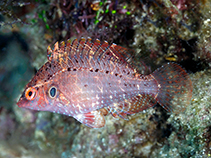
Rückenflossenstacheln (insgesamt) : 10; Rückenflossenweichstrahlen (insgesamt) : 9 - 10; Afterflossenstacheln: 3; Afterflossenweichstrahlen: 9. This species can be distinguished from its congeners by the following set of characters: D X, 9-10; GR 10-15 (modally 12, rarely 14 or 15); D-X relatively short, measuring 14.3-20.6% of SL (mean 17.0%); longest pelvic-fin soft ray length 16.5-24.3% of SL (20.4%); dorsal profile of head straight; presence of filamentous membrane tips on the first 2-3 dorsal-fin spines in terminal phase males; anal-fin spines with relatively short filamentous membrane tips. Colouration: Body typically reddish-brown, with no black spots on abdomen; dark brown margin in anterior nostril, with large circular or elliptical dark brown blotch (roughly eye size) surrounded by faint yellow or orange on upper opercle; dark brown spot typically below the base of last D soft ray; a few small dark brown spots on mid-lateral surface of body; three slightly curved bluish-gray vertical lines usually on cheek below eye when the specimen is fresh; distinct white stripe usually on head extending from snout tip to upper end of opercle through upper part of iris (visible in fresh or live specimen); a dark brown spot on the membrane between 1st and 2nd D spines (sometimes indistinct in life); usually pale reddish-white with a broad reddish-brown band medially pelvic fin coloration (Ref. 130185).
Cross section: compressed.
This species is typically found in coral reef habitats along the shore, including lagoons, patch reefs, and pinnacle reefs, where it takes shelter among soft corals and benthic algae (Refs. 649, 2334). It also inhabits areas with coral rubble, sandy substrates, and both live and dead corals (Ref. 649)
Lebenszyklus und Paarungsverhalten
Geschlechtsreife | Fortpflanzung | Ablaichen | Eier | Fruchtbarkeit | Larven
Oviparous, distinct pairing during breeding (Ref. 205).
Iino, T. and H. Motomura, 2022. Pteragogus turdus, a new species of wrasse (Perciformes: Labridae) from the Indo-West Pacific Ocean. Ichthyol. Res. 70:207-214. (Ref. 130185)
IUCN Rote Liste Status (Ref. 130435: Version 2025-2 (Global))
Bedrohung für Menschen
Harmless
Nutzung durch Menschen
Fischereien: nicht kommerziell
Tools
Zusatzinformationen
Download XML
Internet Quellen
Schätzungen auf der Grundlage von Modellen
Phylogenetischer Diversitätsindex (Ref.
82804): PD
50 = 0.5005 [Uniqueness, from 0.5 = low to 2.0 = high].
Bayesian length-weight: a=0.01072 (0.00427 - 0.02691), b=3.03 (2.81 - 3.25), in cm total length, based on LWR estimates for this (Sub)family-body shape (Ref.
93245).
Trophische Ebene (Ref.
69278): 3.4 ±0.4 se; based on size and trophs of closest relatives
Widerstandsfähigkeit (Ref.
120179): hoch, Verdopplung der Population dauert weniger als 15 Monate. (Preliminary K or Fecundity.).
Anfälligkeit der Fischerei (Ref.
59153): Low vulnerability (10 of 100).
🛈