Klassifizierung / Names
Namen | Synonyme | Catalog of Fishes(Gattung, Arten) | ITIS | CoL | WoRMS | Cloffa
>
Cypriniformes (Carps) >
Cyprinidae (Minnows or carps) > Torinae
Etymology: Hypselobarbus: Greek, hypselos = high + Latin, barbus =barbel (Ref. 45335); procerus: Name from Latin 'procerus' meaning ‘high’, referring to the exceptionally deeper body of the new fish.
Umwelt: Milieu / Klimazone / Tiefenbereich / Verbreitungsgebiet
Ökologie
; süßwasser benthopelagisch. Tropical
Verbreitung
Territorien | FAO Gebiete | Ökosysteme | Vorkommen | Punkt Karte | Einführungen | Faunafri
Asia: India.
Größe / Gewicht / Alter
Geschlechtsreife: Lm ? range ? - ? cm
Max length : 11.2 cm SL Männchen/unbestimmt; (Ref. 132421)
Kurzbeschreibung
Bestimmungsschlüssel | Morphologie | Morphometrie
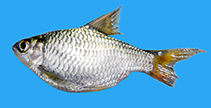
Rückenflossenweichstrahlen (insgesamt) : 8; Afterflossenweichstrahlen: 5. This species is distingushed by the following characters: plain- without any colour spots; deep body, its depth at dorsal fin origin 39.5-44.9 % SL, depth at anal fin 26.3-28.2 % SL; barbels 2 pairs; head long, 29.7- 32.2 % SL and wide, 20.7- 22.3 % SL; last unbranched dorsal-fin ray very strong, osseous and smooth, branched dorsal fin rays 8; branched ventral fin rays 7-8; branched anal fin rays 5; lateral line scales 30-32; anal fin long, 1.9 - 23.9 % SL, reaching caudal fin (Ref. 132421).
Body shape (shape guide): short and / or deep; Cross section: oval.
The type locality of this species is generally rocky substratum; with boulders, patches of cobbles and gravelly sand occur at certain places. The width of the river channel at the collection site was 9 m and characterized by intermittent occurrence of dense riparian vegetation. Associated species include the following: Mastacembelus malabaricus, Danio malabaricus, Barilius rogosus, Rasbora dandia, Dawkinsia filamentosa, Glyptothorax annandalei, G. anamalaiensis, Hemibagrus punctatus, Mystus seengti, Osteochilichthys brevidorsalis, Haludaria fasciatus among others (Ref. 132421).
Lebenszyklus und Paarungsverhalten
Geschlechtsreife | Fortpflanzung | Ablaichen | Eier | Fruchtbarkeit | Larven
Plamoottil, M., 2021. Hypselobarbus procerus, a new cyprinid fish species from Kerala, India. Uttar Pradesh J. Zool. 42(24):696-705. (Ref. 132421)
IUCN Rote Liste Status (Ref. 130435: Version 2025-2 (Global))
Bedrohung für Menschen
Harmless
Nutzung durch Menschen
Fischereien: nicht kommerziell
Tools
Zusatzinformationen
Download XML
Internet Quellen
Schätzungen auf der Grundlage von Modellen
Phylogenetischer Diversitätsindex (Ref.
82804): PD
50 = 0.5000 [Uniqueness, from 0.5 = low to 2.0 = high].
Bayesian length-weight: a=0.01995 (0.00906 - 0.04395), b=3.01 (2.83 - 3.19), in cm total length, based on all LWR estimates for this body shape (Ref.
93245).
Widerstandsfähigkeit (Ref.
120179): hoch, Verdopplung der Population dauert weniger als 15 Monate. (Preliminary K or Fecundity.).
Anfälligkeit der Fischerei (Ref.
59153): Low vulnerability (10 of 100).
🛈