>
Siluriformes (Catfishes) >
Heteropneustidae (Airsac catfishes)
Etymology: Heteropneustes: Greek, heteros = other + Greek, pneo = to breath (Ref. 45335); fuscus: Name from Latin 'fuscus' meaning dark; referring to the lack of colored body and fins of the new species.
Ambiente: milieu / zona climática / intervalo de profundidade / gama de distribuição
Ecologia
; Água doce demersal. Tropical
Distribuição
Territórios | Áreas FAO | Ecossistemas | Ocorrências | Mapa dos pontos | Introduções | Faunafri
Asia: India.
Tamanho / Peso / Idade
Maturidade: Lm ? range ? - ? cm
Max length : 15.7 cm SL macho/indeterminado; (Ref. 132393)
Descrição breve
Chaves de identificação | Morfologia | Morfometria
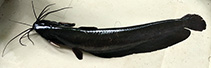
Raios dorsais moles (total) : 4 - 5; Raios anais moles: 72 - 75; Vértebras: 58 - 60. This species is distinguished from its congeners by the following characters: deep black body and fins; differs from H. fossilis in having a deep black body (vs. chocolate to dark brown color), fins deep black (vs. light brown) and with cephalic fontanel broader and deeper (Ref. 132393).
Cross section: circular.
The species was collected from a stream bed dominated by mud sediments; sand occurs as discrete patches within the mud dominant deposits; depth and width of the area are 0.3-0.7 m and 6.0-7.0 m, respectively; the bank height is 2.0-3.0 m above the water level during summer. This area is also covered by dense to moderate riparian vegetation; intermittent occurrence of low riparian vegetation observed at certain places. Major flora includes Ochreinauclea missionis, Hibiscus tiliaceus, Bambusa bambos, B. vulgaris. etc. Associated fish species in the region are the following Haludaria fasciata, Labeo rohita, L. dussumieri, Osteobrama bakeri, Amblypharyngodon microlepis, Rasbora dandia, Dawkinsia filamentosa, Puntius parrah, P. nelsoni, P. viridis, Pethia ticto, Hypselobarbus kurali, Devario malabaricus, Tor khudree, Horabagrus brachysoma, Mystus keralai, Mystus indicus, Wallago attu, Macrognathus albus. It is an economically important catfish in inland capture and culture fisheries. In central Travancore these fishes are caught by gill nets, cast nets, traps and hooks and are sold in large quantities in live condition. Sometimes transported to distant markets, sold alive after several days due to having the air breathing apparatus. Valued as food fish due to its palatability and nutritional quality, and also used as an ornamental fish and found in the aquarium trade (Ref. 132393).
Ciclo de vida e comportamento de acasalamento
Maturidade | Reprodução | Desova | Ovos | Fecundidade | Larvas
Plamoottil, M., 2021. Heteropneustes fuscus (Siluriformes: Heteropneustidae), a new catfish species from Kerala, India. Biodiversitas 23(1):87-98. (Ref. 132393)
Categoria na Lista Vermelha da IUCN (Ref. 130435: Version 2025-2 (Global))
Ameaça para o homem
Harmless
Utilização humana
Pescarias: espécies comerciais; Aquário: Espécies comerciais
Ferramentas
Relatórios especiais
Descarregue XML
Fontes da internet
Estimativas baseadas em modelos
Índice de diversidade filogenética (Ref.
82804): PD
50 = 0.5312 [Uniqueness, from 0.5 = low to 2.0 = high].
Bayesian length-weight: a=0.00437 (0.00193 - 0.00988), b=3.09 (2.88 - 3.30), in cm total length, based on LWR estimates for this (Sub)family-body shape (Ref.
93245).
Nível Trófico (Ref.
69278): 3.3 ±0.5 se; based on size and trophs of closest relatives
Resiliência (Ref.
120179): Elevada, tempo mínimo de duplicação da população menor que 15 meses (Preliminary K or Fecundity.).
Vulnerabilidade da pesca (Ref.
59153): Low vulnerability (10 of 100).
🛈