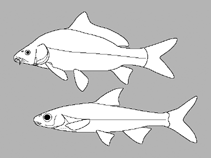
Classificação / Nomes
Nomes comuns | Sinônimos | Catalog of Fishes(Gênero, Espécies) | ITIS | CoL | WoRMS | Cloffa
>
Cypriniformes (Carps) >
Cyprinidae (Minnows or carps) > Torinae
Etymology: Carasobarbus: Latinization of , karass, karausche, European crucian carp + Latin, barbus = barbel (Ref. 45335).
Meio ambiente: milieu / Zona climática / intervalo de profundidade / faixa de distribuição
Ecologia
; Água doce bentopelágico. Tropical
Asia: Iran.
Tamanho / Peso / Idade
Maturidade: Lm ? range ? - ? cm
Max length : 18.8 cm SL macho/indeterminado; (Ref. 132288)
Descrição suscinta
Chaves de identificação | Morfologia | Morfometria
This species is distinguished by the following characters: lateral line scales 38-40; with two pairs of barbels; a well-developed median lobe on the lower lip (Ref. 132288).
Cross section: oval.
This species is usually found in the deeper parts of rivers and dam reservoirs, where water flow are slower and with ample vegetation and cover. During the summer months, it swims into faster-flowing waters as well, likely due to warming water temperatures in their typical habitat. It prefers areas along the banks and around islands where tree roots and aquatic plants are available which allows it to forage while remaining hidden among the vegetation to avoid predators. It appears to be most abundant in the middle and lower Karun. Associated species include Luciobarbus barbulus, Capoeta aculeate, Garra rufa, Chondrostoma regium, Alburnus sellal, Squalius lepidus, Squalius berak and Glyptothorax cous (Ref. 132288).
Ciclo de vida ou comportamento de acasalamento
Maturidade | Reprodução | Desova | Ovos | Fecundidade | Larvas
Jouladeh-Roudbar, A., C. Kaya, S. Vatandoust and H.R. Ghanavi, 2024. New insights into the phylogeny of Carasobarbus Karaman, 1971 (Actinopterygii, Cyprinidae) with the description of three new species. Scientific Reports 14(21801):1-22. (Ref. 132288)
Status na Lista Vermelha da UICN (Ref. 130435: Version 2025-2 (Global))
Ameaça para os humanos
Harmless
Uso pelos humanos
Pescarias: sem interesse
Ferramentas
Relatórios especiais
Baixar XML
Fontes da internet
Estimativas baseadas em modelos
Índice de diversidade filogenética (Ref.
82804): PD
50 = 0.5001 [Uniqueness, from 0.5 = low to 2.0 = high].
Bayesian length-weight: a=0.00955 (0.00430 - 0.02123), b=3.02 (2.83 - 3.21), in cm total length, based on LWR estimates for this (Sub)family-body shape (Ref.
93245).
Nível Trófico (Ref.
69278): 3.0 ±0.4 se; based on size and trophs of closest relatives
Resiliência (Ref.
120179): médio(a), tempo mínimo de duplicação da população 1,4 - 4,4 anos (Preliminary K or Fecundity.).
Vulnerabilidade da pesca (Ref.
59153): Low vulnerability (13 of 100).
🛈